
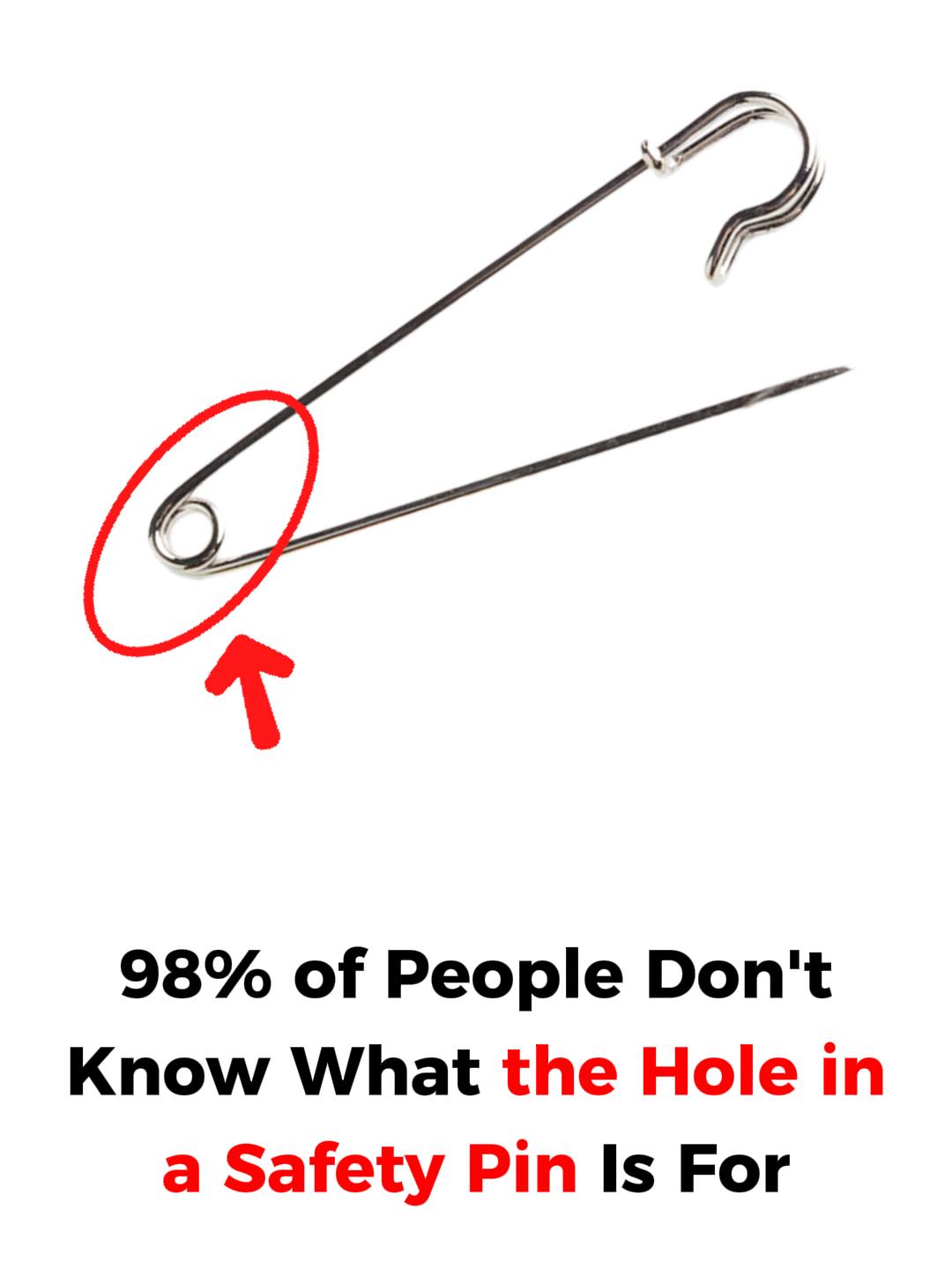
Most of us have used safety pins our entire lives without ever stopping to question their design. We reach for one when a zipper breaks, a hem falls loose, or a button pops off at the worst possible moment. They just work. But have you ever looked closely at that tiny little hole sitting right in the center of the coiled end? Most people assume it is simply there by accident — a leftover quirk from the manufacturing process, or maybe just a design flourish with no real meaning. As it turns out, that small hole is anything but accidental. It is actually one of the most important features of the entire pin.
There Are Actually Two Holes — Not One
Here is something most people do not realize: a safety pin actually has two holes, not one. The first is at the top, where the sharp tip locks into the protective metal clasp. The second — the one that confuses most people — is at the bottom, right inside the coiled spring. And according to Larry Schwartz, the CEO of Wholesale Safety Pins, one of the last domestic safety pin manufacturers in the United States, both holes serve a very specific and intentional purpose.
The hole at the top clasp takes some of the pressure off so you can flex the pin more easily when opening and closing it. It also allows the sharp tip of the pin to slide smoothly in and out of the protective metal shield — which is literally what puts the “safe” in safety pin. Without this hole, the tip would not seat as cleanly, making the pin both harder to use and more dangerous.
The Real Purpose of the Hole in the Coil
The hole at the bottom — the one inside the spring coil — is where things get genuinely fascinating. This tiny opening is the structural anchor point of the entire spring mechanism. Here is how it works: when a safety pin is manufactured, a straight piece of high-carbon steel wire is grabbed at one end and tightly wound around a small metal rod called a mandrel. During this coiling process, the hole marks the very center of the spiral — the precise point where the wire is anchored as it is twisted into that tight, controlled coil.
