
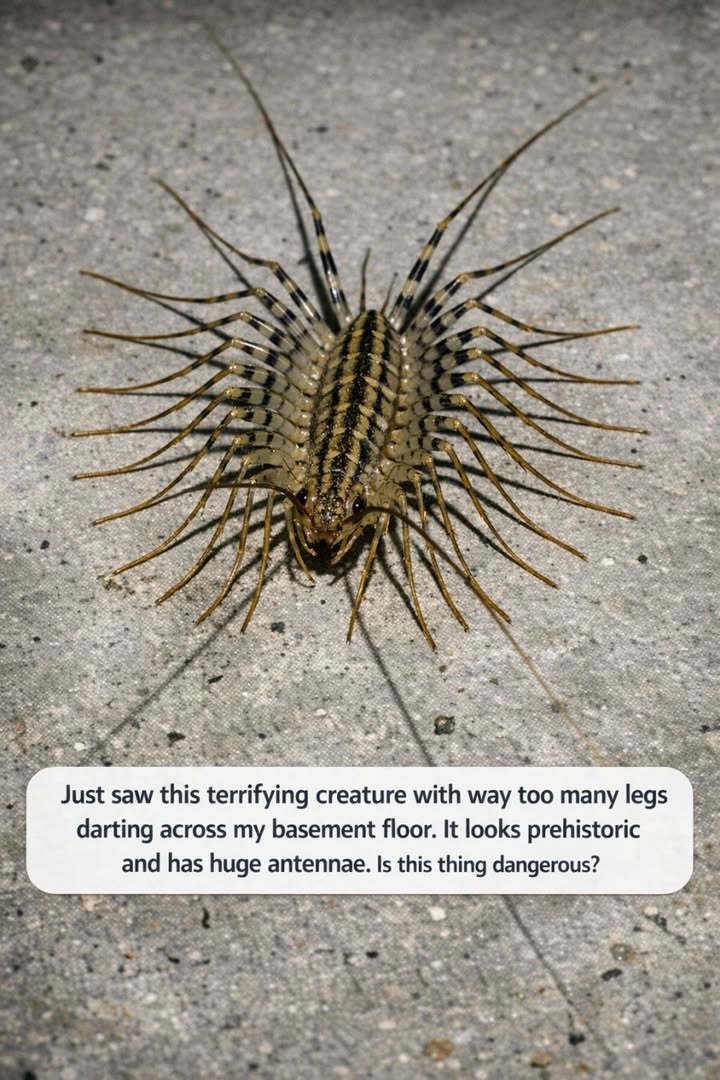
This is genuinely a matter of personal preference rather than necessity. House centipedes do not need to be eliminated from a health or safety standpoint. Many homeowners, once they understand what the animal is and what it does, choose to leave it alone and allow it to continue its work — a reasonable decision given that it is providing a measurable service at no cost. If you find one in a living area and want it out of the house, the most effective approach is to capture it in a container and release it outside in a sheltered spot: a woodpile, a rock pile, or dense leaf litter are all suitable environments where it will be perfectly happy and will continue hunting outdoor pest populations. Killing it achieves the same result in terms of removing it from your immediate environment but eliminates the pest control benefit.
If you want to reduce house centipede populations in your home over time, the most effective approach is not pesticides — house centipedes hold their bodies elevated on their long legs, which means they have minimal contact with treated surfaces, making most pesticide applications largely ineffective against them. The more practical approach is to address the conditions that attract them: reduce basement humidity with a dehumidifier or improved ventilation, seal cracks and crevices in basement walls and floors to eliminate harborage sites, ensure good drainage around the foundation to keep moisture levels down, and address any underlying prey populations that may be providing the centipedes with a reliable food source. Reducing the humidity and eliminating the prey population tends to cause house centipede numbers to decline naturally over time, without requiring direct intervention against the centipedes themselves.
The house centipede is, by most objective measures, one of the stranger and more visually alarming things that you are likely to encounter in the spaces of your own home. It looks prehistoric because it is — this lineage has existed largely unchanged for a very long time, and the design has proven effective enough that evolution saw no particular reason to revise it. But it is not a threat. It is, in its own unsettling way, doing you a favor. And now that you know what it is and what it is doing there, the next time it darts across the basement floor in that alarming way, you might be able to take a breath before reaching for something to hit it with. Or at least a slightly longer breath than before.
