
Bumps and blisters in the mouth: causes, symptoms and treatment
What are they?
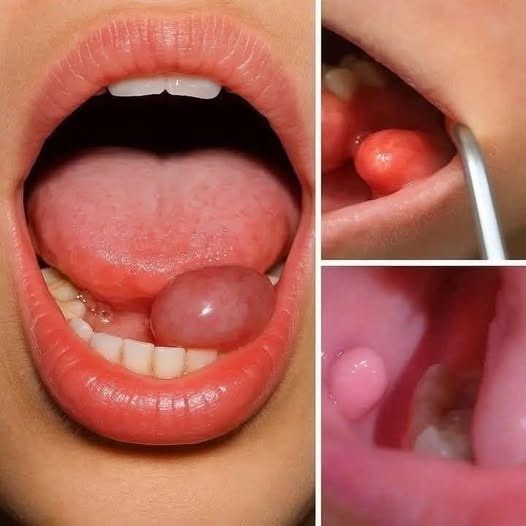
The appearance of small bumps or vesicles in the oral cavity can be worrisome, especially if they are large, filled with fluid, or interfere with eating and speaking. The most common benign growths with this appearance are mucoceles and ranulas.
mucocele
What is a mucocele?
A mucocele is a mucinous (mucous) cyst that forms when saliva accumulates in the surrounding tissues due to:
salivary duct obstruction
Rupture of the canal following a bite or trauma
It most often forms inside the lower lip, but can also form in other places (under the tongue, on the cheeks, on the palate).
Continued on the next page.
What does it look like?
A soft, translucent or bluish mass
Size ranging from a few millimeters to a few centimeters
When pressed, it can burst and release clear mucus.
Ranule
What is a ranula?
A ranula is a particular type of mucocele that develops at the back of the mouth, under the tongue. It originates from a major salivary gland (sublingual gland).
Features:
Being larger in size, it can fill a significant portion of the floor of the mouth.
Bubble appearance
May make chewing and speaking difficult.
Other possible causes of mouth swelling
Besides mucoceles and ranulas, these formations can, more rarely, be caused by:
Fibroid – a benign, hard tumor of connective tissue
Papilloma – a benign, wart-like growth, often caused by HPV
Inflammatory granuloma – a reaction to chronic irritation
Salivary gland tumors (less frequent, sometimes malignant)
Symptoms
A lump or a blister
Sensation of a “lump” in the mouth
Sometimes, pain is due to trauma
Discomfort during consumption or speaking
During the rupture – mucus leakage
Diagnosis
For a definitive diagnosis, an examination by a dentist or maxillofacial surgeon is necessary, who will assess:
the location and size
consistency
Is it painful?
the limitation period
history of trauma or biting
In some cases, the following operations are performed:
ultrasound examination
biopsy (if a tumor is suspected)
Treatment
❗️ Important: Mucoceles and ranulas do not disappear permanently on their own, although they sometimes shrink temporarily when they burst.
Most common methods:
✅ Surgical removal of the cyst and associated duct
✅ Marsupialization: opening and suturing of the edges to prevent recurrence of obstruction
✅ For small mucoceles, careful monitoring is sometimes necessary in the absence of symptoms, but recurrences are very common.
It is not recommended to pierce or squeeze a pimple yourself as this leads to infection and its recurrence.
Continued on the next page:
Symptoms
A lump or a blister
Sensation of a “lump” in the mouth
Sometimes, pain is due to trauma
Discomfort during consumption or speaking
During the rupture – mucus leakage
Diagnosis
For a definitive diagnosis, an examination by a dentist or maxillofacial surgeon is necessary, who will assess:
the location and size
consistency
Is it painful?
the limitation period
history of trauma or biting
In some cases, the following operations are performed:
ultrasound examination
biopsy (if a tumor is suspected)
Treatment
❗️ Important: Mucoceles and ranulas do not disappear permanently on their own, although they sometimes shrink temporarily when they burst.
Most common methods:
✅ Surgical removal of the cyst and associated duct
✅ Marsupialization: opening and suturing of the edges to prevent recurrence of obstruction
✅ For small mucoceles, careful monitoring is sometimes necessary in the absence of symptoms, but recurrences are very common.
It is not recommended to pierce or squeeze a pimple yourself as this leads to infection and its recurrence.
When should you see a doctor?
Consult immediately if:
The swelling increases rapidly
there is intense pain
hinders eating and swallowing
bleeding or pus is flowing
persists for more than 2 to 3 weeks without improvement
Conclusion
The appearance of a small bump or blister in the mouth is most often due to a benign condition, such as a mucocele or ranula. These lesions are usually easily treated surgically, but a diagnosis by a specialist is essential. If you notice such a formation, consult a dentist or oral and maxillofacial surgeon without delay.
Important note:
This article is provided for informational purposes only and is not a substitute for consultation, diagnosis, or treatment by a qualified healthcare professional. If you experience any lumps, pain, or other symptoms in your mouth, it is essential to consult a dentist or oral surgeon for an examination. Do not self-medicate without medical advice.
