
Food availability may indirectly contribute as well. Lizards often stay near places where insects are common. Bedrooms can attract insects drawn to lights, clothing, dust, or small food particles. If a female lizard already spends much of her time near the bedroom because prey is available, she may eventually choose a nesting site nearby.
The construction of modern furniture can also create ideal hiding spaces. Wooden bed frames often contain narrow crevices, protected corners, and sheltered gaps. These structures can resemble the natural cracks and rock crevices that many lizards use in the wild. To a lizard, the space around a bed may feel very similar to a safe natural nesting environment.
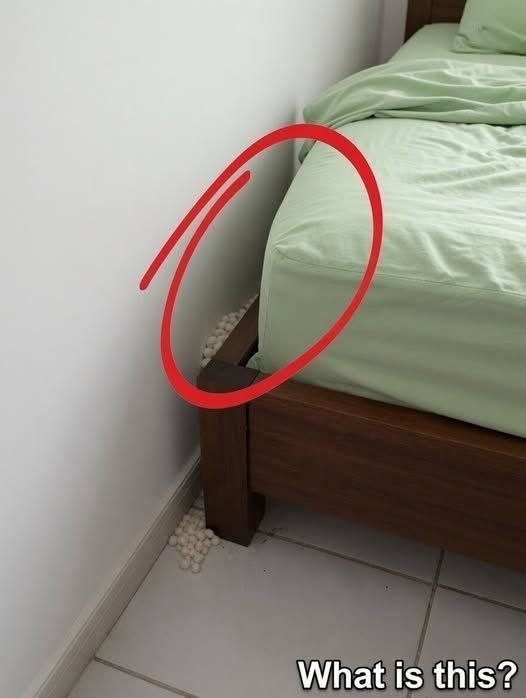
However, there is an important detail regarding the image you showed earlier. Typical house gecko eggs usually do not appear in large clusters containing dozens of perfectly identical spheres. Most geckos lay only one or two eggs at a time. The eggs are generally larger than many people expect and often have a hard, chalky shell. They are usually attached to a surface rather than scattered loosely like marbles.
If those objects were truly lizard eggs, finding such a large quantity would be unusual and might suggest multiple females using the same nesting site over an extended period. Even then, the extremely uniform appearance of the objects in the image makes them look more like manufactured materials than natural eggs.
If actual lizard eggs are present in a bedroom, there are several signs that may accompany them. You might occasionally see geckos on walls or ceilings during the evening. Small droppings may be visible near windows, light fixtures, or corners. Sometimes faint chirping sounds can be heard at night, especially from certain gecko species. Increased insect activity may also attract more lizards into the home.
