
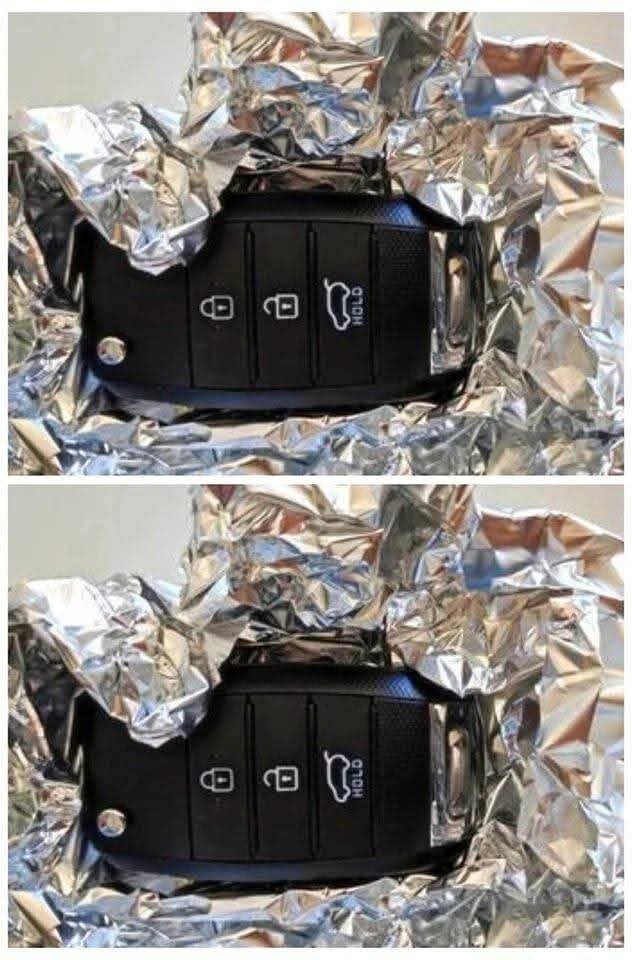
Why Some Drivers Wrap Their Car Keys in Aluminum Foil
It may sound strange, but some drivers have started wrapping their car keys in aluminum foil or keeping them inside special signal-blocking pouches.
The reason has nothing to do with protecting the key from physical damage.
It has to do with modern keyless car theft.
The Hidden Risk of Keyless Cars
Many modern vehicles allow drivers to unlock the doors and start the engine without taking the key fob out of their pocket.
The car detects the wireless signal from the key and recognizes that the authorized key is nearby.
This is extremely convenient.
However, certain keyless systems can potentially be targeted using a technique known as a relay attack.
In a relay attack, criminals attempt to extend the communication between a vehicle and its key fob, making the car behave as though the legitimate key is much closer than it really is.
The physical key may still be safely inside the owner’s home.
How Can This Happen?
Imagine that your car is parked outside your house while your key is sitting on a table near the front door.
A thief may attempt to use electronic equipment to relay the communication between the vehicle and the key.
If the system is vulnerable, the vehicle may recognize the signal and unlock.
The criminals may then attempt to start the vehicle and drive away.
This is why simply saying, “My keys are inside the house, so my car is safe,” isn’t always enough for certain keyless systems.
Why Aluminum Foil?
Aluminum is a conductive metal and can interfere with radio-frequency signals.
That’s the basic idea behind signal-blocking containers, commonly known as Faraday pouches or Faraday bags.
When a key fob is properly enclosed inside a signal-blocking material, its wireless communication can be significantly reduced or blocked.
This can make it much more difficult for someone outside the house to interact with the key’s signal.
However, there is an important warning:
Wrapping a key in ordinary kitchen foil is not a guaranteed security solution.
Small gaps, tears, or incomplete coverage can allow signals to escape.
A purpose-built signal-blocking pouch is generally a more reliable option.
Test Your Key Pouch
If you purchase a signal-blocking pouch, don’t simply assume that it works.
Test it yourself.
Put the key inside the pouch and stand near your vehicle.
Try to unlock the car using the normal keyless-entry function.
If the vehicle still recognizes the key, the pouch may not be blocking the signal effectively.
It’s also a good idea to test the pouch periodically to make sure it continues to work properly.
Keep Your Keys Away From the Front Door
Another simple precaution is to change where you keep your keys.
Don’t leave your key fob directly beside the front door or next to a window.
Instead, keep it somewhere farther inside your home.
The same applies to your spare key.
Many people protect their everyday key but forget that a spare key may also transmit a wireless signal.
Both keys should be treated as part of the vehicle’s security system.
Can You Turn Off the Key’s Signal?
Some key fobs have a feature that allows their wireless functions to enter a sleep mode or be disabled.
The method varies depending on the vehicle and key.
Some systems do this automatically after the key has been stationary for a certain amount of time.
Others may offer a manual option.
Check your vehicle’s owner’s manual to find out whether your particular key supports this feature.
Don’t assume that a method that works for one car will work for another.
Add Physical Security
Electronic protection isn’t your only option.
A physical steering-wheel lock can provide another layer of protection.
Even if someone manages to overcome the vehicle’s electronic security, a physical barrier can make the car more difficult to drive away.
This is an example of layered security.
Instead of relying on one protection method, you combine several.
Park Somewhere Secure
Where you leave your vehicle can also make a difference.
If you have a locked garage, using it can provide an additional physical barrier.
If you park outside, good lighting and security cameras can make the location less attractive to thieves.
A locked gate, driveway security, and other physical deterrents can also help.
The goal is not to make the vehicle impossible to steal.
The goal is to make it a less convenient target.
Make Sure Your Car Actually Locked
One of the simplest things you can do is also one of the easiest to forget.
After locking your car, check that the doors are actually secured.
Continue reading on the next page
