
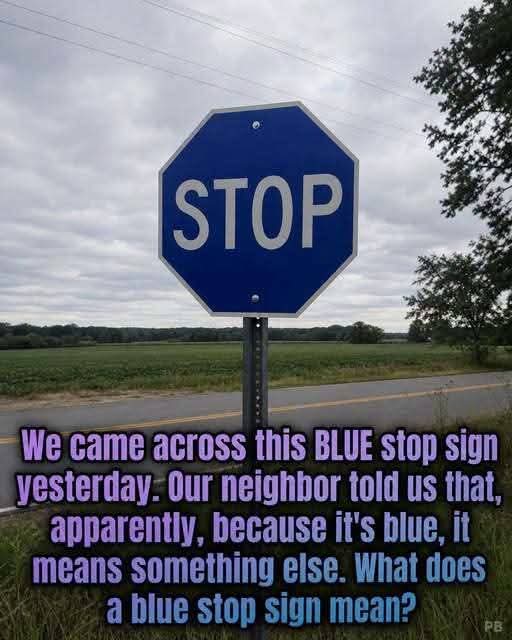
Why Would Someone Choose Blue?
One important reason is differentiation.
A private property owner may want drivers to understand that the sign is part of the property’s own traffic-control system rather than a standard government road sign.
Blue also has a completely different visual association from red. In conventional traffic-sign systems, blue is commonly associated with information or services rather than stopping.
That makes a blue stop sign unusual enough to stand out.
However, the exact use and legal significance of a blue stop sign can vary depending on the location and local regulations.
The Shape Still Matters
Even though the color is different, the eight-sided shape is a major clue.
The octagonal shape is strongly associated with stopping. Drivers are trained to recognize it immediately, even when the sign is viewed from the back or from an angle.
That’s why a blue octagonal sign displaying the word STOP is unlikely to be something you should simply drive past.
The unusual color should make you more cautious, not less.
Where Are Blue Stop Signs Most Common?
Blue stop signs are particularly associated with private areas and have also been reported in places such as Hawaii.
They may be used in private communities, parking areas, business properties, or locations where property owners need to organize vehicle movement.
You may never encounter one during ordinary driving, which is precisely why seeing one can feel so strange.
For someone who has only ever seen red stop signs, the first reaction is often:
“Is this actually a stop sign?”
The answer is that it can still be a clear instruction to stop, even though its legal status may differ from a standard public-road sign.
What Should You Do If You See One?
The safest approach is very simple:
Stop.
Come to a complete stop, look carefully for pedestrians and other vehicles, and continue only when the area is safe.
There is little benefit in taking a chance simply because the sign is blue.
Whether you’re driving through a parking lot, a private neighborhood, a business complex, or another controlled area, following posted safety instructions helps protect everyone around you.
A Small Sign With an Important Lesson
The blue stop sign is a good reminder that road safety isn’t always as simple as memorizing colors.
We’re accustomed to seeing red and automatically thinking “stop.” When the familiar pattern changes, we may hesitate or question what we’re seeing.
But when driving, uncertainty should lead to more caution, not less.
A strange-looking sign doesn’t necessarily mean that the instruction behind it should be ignored.
So if you ever come across a blue stop sign, don’t assume that someone simply installed the wrong sign.
Slow down.
Stop.
Look around.
And make sure the road is clear before continuing.
Because regardless of the color, the safest rule is often the simplest one: when a sign tells you to stop, stop.
