
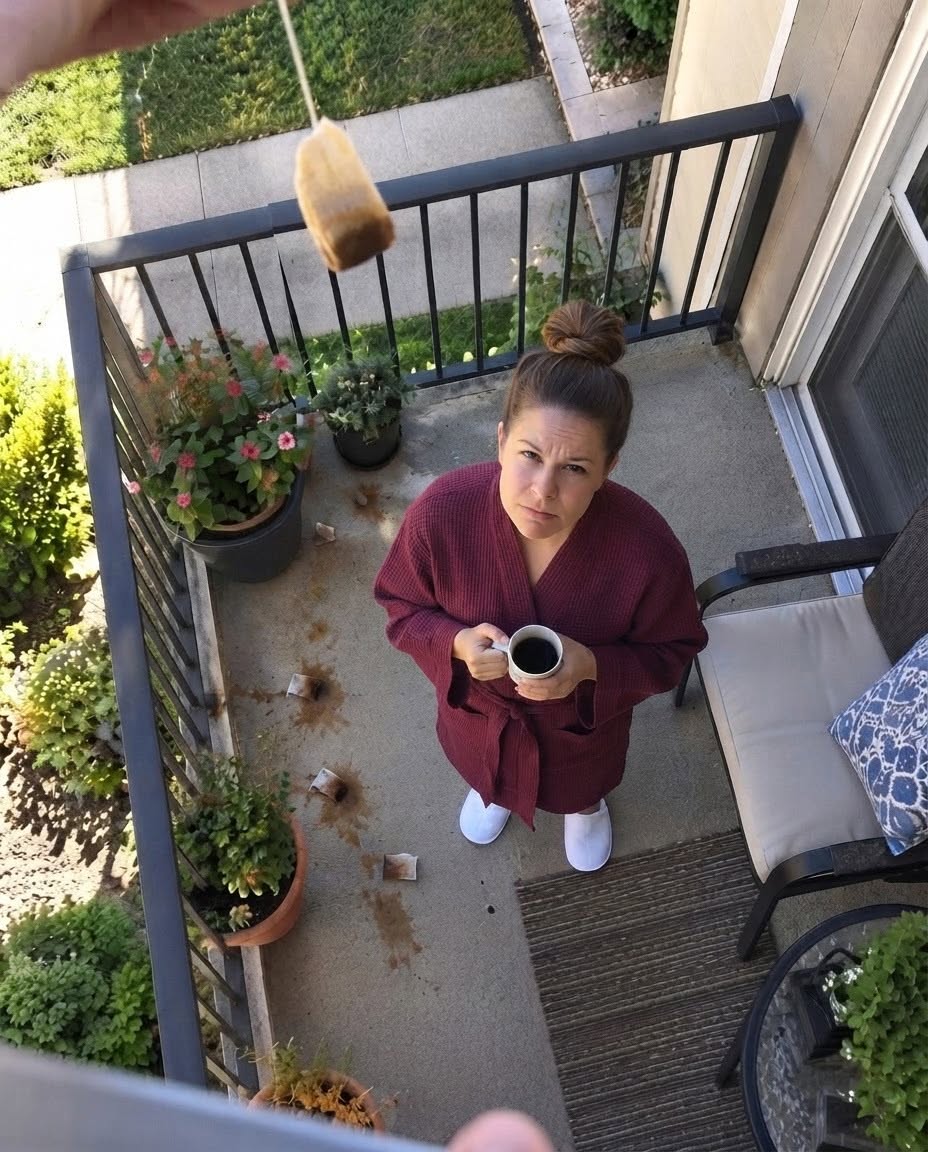
But I am not going to tell you that’s where the story ends.
Because two weeks after the management company letter, something else happened.
I came home on a Thursday afternoon to find a note in my mailbox. Not from the management company — a handwritten note, on a piece of paper folded once, with 3B written on the outside in handwriting I didn’t recognize.I took it upstairs and opened it at my kitchen table.
You could have just talked to me, it said. I would have stopped. You didn’t have to go to management.
I read it twice.
I folded it back along the crease.
I found that I had a number of responses to this note available to me, ranging from the reasonable to the considerably less reasonable, and I sat at my kitchen table for a moment deciding which direction to take.
Then I got out a piece of paper and wrote a reply.
It was brief.
I did talk to you, I wrote. Twice. The first time you said you’d stop and didn’t. The second time you told me I was lucky it was tea bags and shut the door. I’m not sure what additional conversation you were hoping for after that.I’ve lived in this building for eleven years. I signed for your packages all last winter. I try to be a good neighbor. That goes both ways.
The tea bags have stopped, which is all I was asking for from the beginning.
I put it in an envelope, wrote 4B on the outside, and put it in his mailbox on my way out the next morning.
He did not respond.
The tea bags did not return.
That could be the whole story.
In some versions, it is. The complaint, the documentation, the administrative resolution, the note, the end. Neighbor mistreats neighbor; neighbor responds systematically; behavior stops. Clean. Proportionate. The appropriate use of available mechanisms.
Ezoic
But the thing about living in a building for eleven years is that you are not operating in a single transaction. You are living in an ongoing relationship with a community, and communities are messy, and the people in them are more than the worst or best thing they have done.
Which is how I came to be standing outside 4B again in late February, six weeks after the complaint, with a very different kind of conversation ahead of me.
It started with Mrs. Okafor in 2C.
She knocked on my door on a Saturday morning, which she had done perhaps a dozen times in the three years I had known her, and she had the look of someone who wanted to say something without quite knowing how to begin.“That man upstairs,” she said, once I had made tea, which I always made when Mrs. Okafor came by because Mrs. Okafor was not a person you invited in without making tea. “Hartley.”
“Yes?”
“He came downstairs and helped me with my shopping last week. Three trips, all the way up. Didn’t ask for anything.”
“That was kind,” I said. I meant it. It was kind.
“He looked tired,” she said. “I asked if he was all right.” She paused. “He said he was going through a difficult time. His mother is unwell. He moved to this building to be closer to her.”I held my cup.
Pregnancy & Maternity
“He didn’t say more than that,” Mrs. Okafor continued, with the particular care of someone who is sharing information without meaning to gossip. “But he looked — thin. And tired in a specific way.”
I thanked her for telling me.
She finished her tea and went home.
I sat at the kitchen table for a while.
I want to be clear about something.
People who are going through difficult times are not thereby entitled to throw tea bags onto their neighbors’ balconies. Grief does not transfer the cost of ruined towels onto the person living below you. Hard circumstances explain behavior, sometimes, but they do not resolve the question of impact.
I know this.
I also know that the man who had leaned on his door frame and told me to be glad it was tea bags was, possibly, a man in a very particular kind of exhaustion — the kind that comes from driving to a hospital and sitting beside someone who is not getting better, and then coming home to a flat you only moved to because of that hospital, and being tired in a way that makes you careless and makes carelessness look, from the outside, like contempt.
I am not saying it excuses it.
I am saying it explains it differently.
I knocked on 4B on a Sunday morning.
Not to apologize — I had nothing to apologize for. Not to retract anything. But because I had been thinking about Mrs. Okafor’s words and about the packages I had signed for all last winter and about what kind of building I wanted to live in, and about the fact that being right and being kind are not mutually exclusive.
He answered the door.
He looked exactly as Mrs. Okafor had described. Tired. Thinner than I remembered. He had the look of someone who has been using all their available energy for something else, something that takes everything, and has nothing left for the edges.
“Mrs. Collier,” he said.
“I heard your mother is unwell,” I said. “I’m sorry.”
Pregnancy & Maternity
He looked at me for a moment.
“Mrs. Okafor,” he said.
“Yes.”
He nodded once. Not defensive. Just acknowledging.
“She’s in a place now,” he said. “Residential. She wasn’t safe at home anymore.” He paused. “I go every day. She doesn’t always know me.”
I thought about my own mother, nine years ago. The particular trajectory of that. The way it consumes you from outside in.
“I’m sorry,” I said again. “That’s a very hard thing.”
He looked at the floor.
“The tea bags,” he said. “I wasn’t — I didn’t think about who was underneath. I didn’t think about it at all, which is —” He stopped. “That’s not an excuse.”
“No,” I said. “But I understand it better now.”
He looked up.
“You filed a formal complaint,” he said.
“You left me the note that said I should have just talked to you,” I said. “I wanted to say, in person: I did. Twice. And it didn’t work. The complaint wasn’t vindictive. It was the available mechanism.”
