
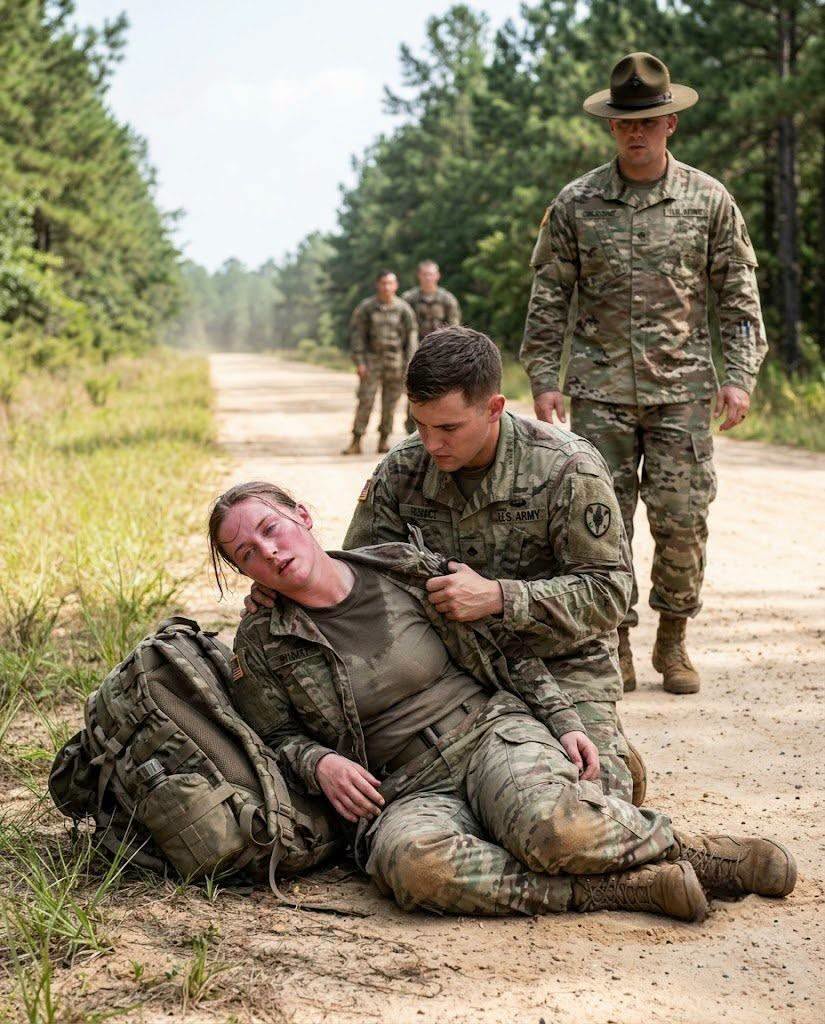
Vega stopped leading our platoon, but nobody told us why. Another instructor took over. My medical profile remained temporary while the raw skin under the strap healed. I watched the rest of the group continue training while I was sent to modified conditioning and follow-up appointments.
I had survived the march.
I had been cleared before it.
People had finally looked at the records.
And I still thought I might lose my place.
One evening I sat outside the barracks with my replacement jacket folded beside me, staring at the tiny holes where the old collar had been cut apart by shears.
I had spent years believing that if I worked hard enough, pain could stay private.
The fire had happened when I was sixteen.
No dramatic rescue. No secret medal. No heroic story I had been waiting to reveal.
A faulty space heater ignited a curtain in the apartment where my mother and I lived. Smoke filled the hallway before either of us understood what was happening. I made it out.
Not cleanly.
Months of grafts followed. Then stretching. Physical therapy. Pressure garments. More surgery. People speaking slowly around me as if burned skin had damaged my hearing too.
By nineteen, I could run again.
By twenty-one, I could lift without guarding my left side.
The scars stayed.
So did the way people looked at them.
That was why I had buttoned the collar.
Not because I was ashamed of surviving.
Because I was tired of survival becoming the first thing anyone knew about me.
Three days before the next training cycle began, Captain Bennett called me back to her office.
A senior selection NCO sat beside her.
My stomach dropped.
Bennett pointed to the chair.
“Your temporary medical restriction ends Friday if the skin check is clean.”
“Yes, ma’am.”
“You missed a required event.”
There it was.
I nodded.
“I understand.”
“Do you?”
I looked up.
The senior NCO slid a form across the desk.
“You’re getting a supervised reattempt. Neutral cadre. Same published standard. No penalty attached to Sergeant Vega’s recommendation.”
For a second I didn’t touch the paper.
Bennett continued.
“The review determined his written assessment relied repeatedly on unsupported assumptions that were inconsistent with your recorded performance. His recommendation has been removed from your selection decision.”
I stared at her.
“Removed?”
“You will be judged on the standard, Mercer. Nothing else.”
That should have felt like victory.
Instead, fear arrived first.
Because now there was nowhere to hide.
No Vega to blame.
No argument about fairness.
Just twelve miles.
Me and the road again.
My reattempt started at 0545 the following Tuesday.
Hayes was there as route support, but he wasn’t allowed to pace me. The evaluator was a staff sergeant I had met only once. He checked my load, recorded the weight, inspected my water, and asked one question.
“Any medical restriction today?”
“No, Sergeant.”
“Then you know the standard.”
That was it.
No joke.
No prediction.
No speech about whether I belonged.
At mile four, my shoulder hurt.
At mile six, I adjusted the strap during the authorized halt and checked the protective dressing exactly the way the clinic had shown me.
At mile eight, the sun climbed higher and sweat ran into my eyes.
My hands trembled once when I opened the canteen.
