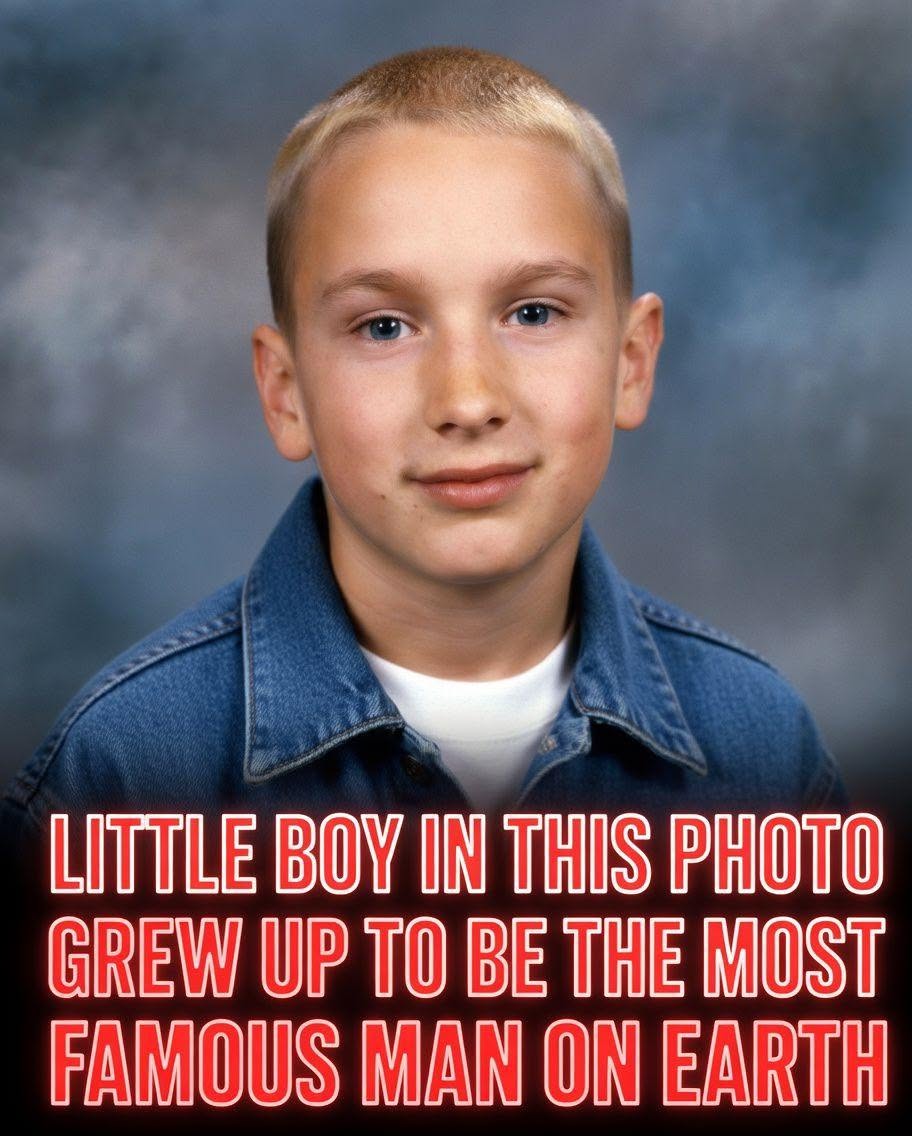
The Boy from Detroit: How Eminem Rhymed His Way Out of Hell
Before the world knew his name, before arenas shook with thousands of voices roaring “Slim Shady!”, he was just a neglected kid named Marshall—shuffled between trailer parks, broken homes, and public school hallways where he never fit in.
Today, he’s not only one of the greatest lyricists to ever pick up a microphone but also an era-defining icon—a man whose ferocious wordplay and raw vulnerability proved that a pen and a pad can turn absolute misery into a global empire.
A Boy and His Notepad
Marshall Bruce Mathers III grew up in a world defined by instability. Raised primarily by a volatile, struggling single mother, his childhood was a chaotic loop of evictions, school changes, and isolation. In the tough neighborhoods of Detroit’s 8 Mile Road, he was a social outcast, frequently targeted and severely beaten by bullies.
But where speech failed him, syllables saved him. Marshall didn’t care for history or math, but he would pore over the dictionary for hours, treating words like puzzle pieces.
“I found something I was good at,” he later reflected. “I wanted to be able to rhyme words that people didn’t think could rhyme. That was my only goal.”
By his teenage years, the painfully shy kid was sneaking into local hip-hop clubs, stepping into the ferocious arena of Detroit’s underground rap battles and demanding respect in a culture that initially dismissed him.
A Reality That Threatened the Dream
By his early twenties, Marshall’s world was at a breaking point. Living in poverty, working grueling hours as a short-order cook for minimum wage, and trying to provide for his newborn daughter, Hailie, his frustrations boiled over. His debut independent album, Infinite, flopped hard, with critics telling him he should try country music instead.
Desperate, broke, and evicted from his apartment just days before Christmas, Marshall hit rock bottom. He swallowed his despair and channeled his rage, anxiety, and dark humor into a malicious, unhinged alter-ego: Slim Shady.
He took his last remaining dollars to fly to the 1997 Rap Olympics in Los Angeles. Though he placed second, a copy of his tape found its way into the hands of legendary producer Dr. Dre.
Dre listened and didn’t care about Marshall’s background or the color of his skin—he only heard an undeniable, once-in-a-generation genius.
The First Breakthrough — From the Underground to the World
In 1999, The Slim Shady LP dropped like an atomic bomb on popular culture. With Dr. Dre’s masterful production backing him, Eminem’s nasal delivery, cartoonish violence, and terrifyingly complex rhyme schemes captivated the youth and horrified parents across the globe.
He wasn’t just a rapper; he was a cultural phenomenon.
By the time he released The Marshall Mathers LP in 2000, he had conquered the music industry, selling an unprecedented 1.76 million copies in its first week alone. He became the voice of an angry, misunderstood generation, shifting the boundaries of free speech and artistic expression forever.
The Golden Era — A Titan Takes Form
Throughout the early 2000s, Eminem transformed hip-hop into a global stadium sport. Year after year, his creative output defied expectation, blending dark comedy with staggering autobiography:
3 Consecutive Grammy Awards for Best Rap Album (Slim Shady LP, Marshall Mathers LP, The Eminem Show)
An Academy Award for “Lose Yourself”—the first rap song to ever win an Oscar
Over 220 million records sold, cementing him as the best-selling artist of the 2000s
His historic rise turned the music industry into theater. While critics protested his lyrics, Eminem used his platform to air out his personal demons, dissecting celebrity culture, political hypocrisy, and his own toxic relationships with surgical precision. On the mic, he was an absolute force—untouchable, relentless, and lightning-fast.
Conquering the Demons
No matter how many stadium tours he sold out, Eminem’s toughest battles were fought away from the cameras.
The relentless pressure of global fame, combined with the baggage of his childhood trauma, pulled him into a severe, near-fatal prescription drug addiction. For years, the music took a backseat to survival. Following a critical overdose in 2007 that nearly cost him his life, Marshall chose to rebuild himself from scratch.
True artists find their strength in recovery. Returning to the studio completely sober, he released Relapse and the multi-platinum Recovery, openly documenting his struggle with dependency. Songs like “Not Afraid” became anthems of resilience for millions of fans fighting their own quiet wars. He had conquered the charts; now, he had conquered himself.
Beyond the Mic — The Reclusive King
Offstage, Eminem has maintained a fiercely private, enigmatic presence.
Rather than chasing Hollywood elite circles, he chose to stay anchored to Michigan, establishing his Shady Records label to launch the careers of powerhouses like 50 Cent and D12. Through his Marshall Mathers Foundation, he has quietly funded millions in charity to help at-risk youth in Detroit, never seeking the spotlight for his generosity.
Yet, despite decades at the top, his work ethic remains that of a starving artist. He still locks himself in rooms for days, filling yellow legal pads with ink, constantly looking for new ways to manipulate the English language.
The Man Behind the Legend
Eminem has never truly left Detroit behind. His heart belongs to his daughters, whom he fiercely protected from the paparazzi throughout his chaotic rise.
Every time he reflects on his journey, he honors the memory of his closest childhood friend, Proof, whose tragic passing deeply scarred him but fueled his determination to keep the Shady legacy alive. He went from a kid who couldn’t pay his utility bills to a father who gave his family everything he never had.
A Legacy Untouchable
Decades into his career, Eminem continues to command the absolute attention of the music world. While hip-hop trends evolve and fade, his lyrical precision remains the gold standard of the genre. His speed has become legendary, setting world records for syllables per second, operating at a level of mental processing that few human beings can match.
From the dilapidated houses of Dresden Street to the Rock and Roll Hall of Fame—every verse he pens is treated as an exercise in absolute mastery.
His accolades are staggering, but his true impact stretches far beyond numbers. He showed a generation that greatness doesn’t care where you start; it doesn’t matter if you’re broken, abandoned, or counted out. You can take all that dirt, throw it into a microphone, and force the world to listen.
More Than a Rapper
Eminem’s journey is no longer just a music story. It’s a human story—of a boy who was told he wouldn’t amount to anything, who packed his trauma into a notebook, and who unapologetically conquered the earth.
He is proof that destiny doesn’t always require a smooth path or a privileged beginning. Sometimes, it just takes an unwavering, obsessive belief in your own voice.
Because somewhere inside every outcast is a quiet little kid from Detroit—staring at a blank page, tapping his foot to a rhythm, and daring to believe his words can shake the foundation of the world