
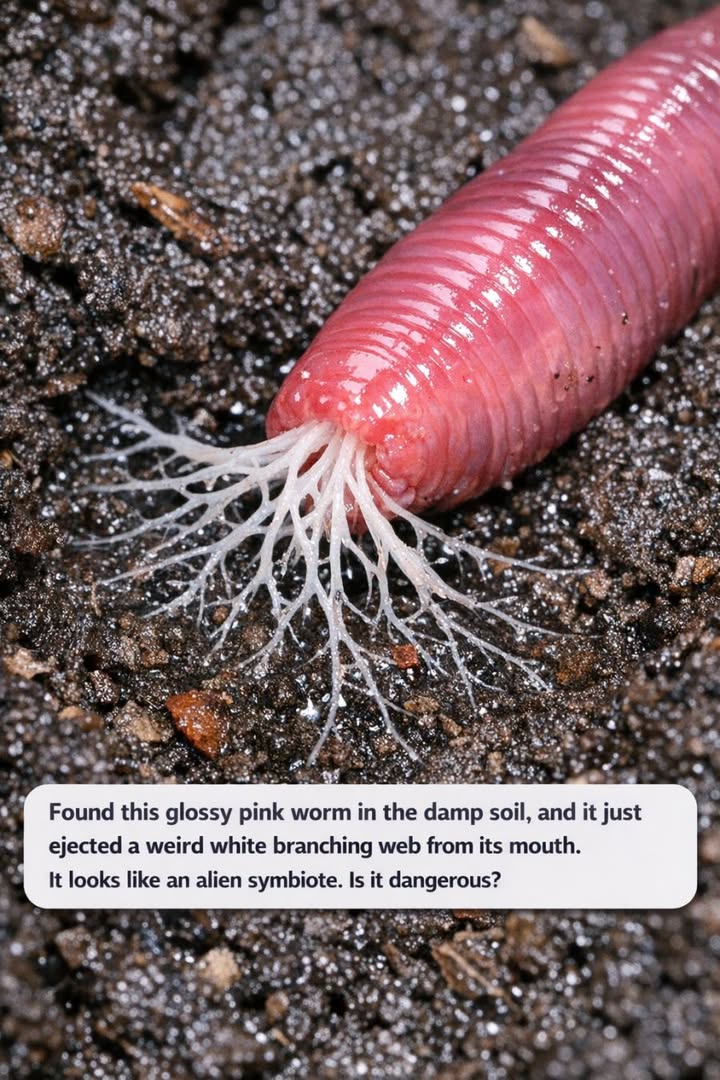
The reaction is understandable. You are turning over soil in the garden, minding your business, and suddenly there it is: a glossy, smooth, pinkish worm-like creature that — just as you lean in for a closer look — ejects a bizarre white branching structure from what appears to be its mouth. The web-like material spreads in multiple directions, looks completely unlike anything a worm should be capable of producing, and has the general appearance of something from a science fiction film. Your first instinct is probably to back away. Your second is to wonder whether you have encountered something genuinely dangerous. The answer to that second question is almost certainly no — but what you have actually found is considerably more interesting than a simple reassurance would suggest.
What You Are Looking At
The creature you have found is almost certainly a ribbon worm — specifically, a member of the genus Gorgonorhynchus or a closely related group within the phylum Nemertea. Ribbon worms are among the least well-known animal groups despite being found in marine, freshwater, and terrestrial environments around the world. They are not worms in the earthworm sense, not related to roundworms or flatworms, and belong to their own entirely distinct animal phylum. The glossy, smooth, pinkish appearance and soft, slightly flattened body are characteristic. What makes certain ribbon worms — including Gorgonorhynchus species — genuinely extraordinary is that white branching structure you witnessed. That is not mucus, not a defense spray, and not a disease symptom. It is the animal's proboscis: a highly specialized hunting organ that the worm fires out from a dedicated opening separate from its mouth at remarkable speed to capture prey.
The Branching Proboscis — One of the Strangest Structures in the Animal Kingdom
Most ribbon worms have a proboscis — a retractable, tube-like hunting appendage that they evert (turn inside out) at high speed to capture prey. In the vast majority of species, this proboscis is a single structure, like a tube or a tongue. But in the genus Gorgonorhynchus and a handful of closely related species, the proboscis branches — splitting into multiple extensions that spread outward like the branches of a tree or the tentacles of a net. This branched proboscis is one of the rarest anatomical structures in the entire animal kingdom. Researchers believe it evolved independently several times in different lineages, which suggests it offers a meaningful advantage for capturing prey — likely allowing the worm to cast a wider net to snare small invertebrates like snails, mollusks, and other small creatures in the surrounding environment.
