
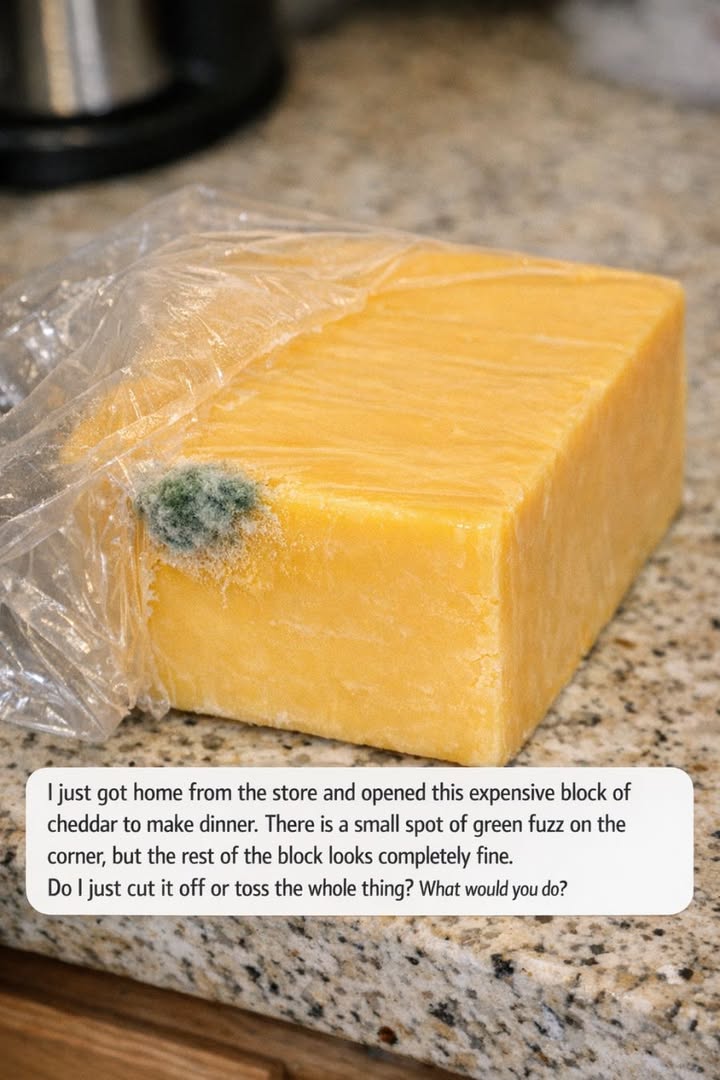
You just got home from the store, opened an expensive block of cheddar to make dinner, and found a small spot of green fuzz on the corner. The rest of the block looks completely fine. Do you cut it off and use the cheese, or throw the whole thing away? It is a genuinely reasonable question, and the answer — perhaps reassuringly — is that for a firm block of cheddar, you almost certainly do not need to throw the whole thing away. But there are rules to follow, and understanding why they exist will help you make the right call every time.
Why the Type of Cheese Is the Deciding Factor
The key variable in any mold-on-cheese situation is moisture content, and it is the reason the rules are completely different for hard cheeses versus soft cheeses. Mold does not just grow on the surface of cheese — it spreads through thread-like structures called mycelium that can burrow beneath the surface. How far those structures penetrate depends on how much moisture is available to support their growth.
In a hard, low-moisture cheese like cheddar, aged parmesan, Gouda, Swiss, or Manchego, the mold's mycelium cannot penetrate very deeply, and any toxins the mold might produce do not diffuse broadly through the dense, dry structure of the cheese. This is why food safety experts consistently say that hard cheeses can be salvaged after a mold spot appears — the contamination stays relatively local, and removing a generous buffer around the visible mold removes the problem.
In soft, high-moisture cheeses — cream cheese, ricotta, fresh mozzarella, Brie, Camembert, cottage cheese, goat cheese, and any spreadable variety — the moisture allows the mold to spread quickly and often invisibly throughout the entire cheese, far beyond what is visible on the surface. The moment you see mold on a soft cheese, the whole thing should be discarded. There is no safe way to cut around it.
Cheddar is a semi-hard to hard cheese depending on age, and it falls firmly in the category that can be salvaged. The green fuzz on your block does not mean you need to throw it away.
