
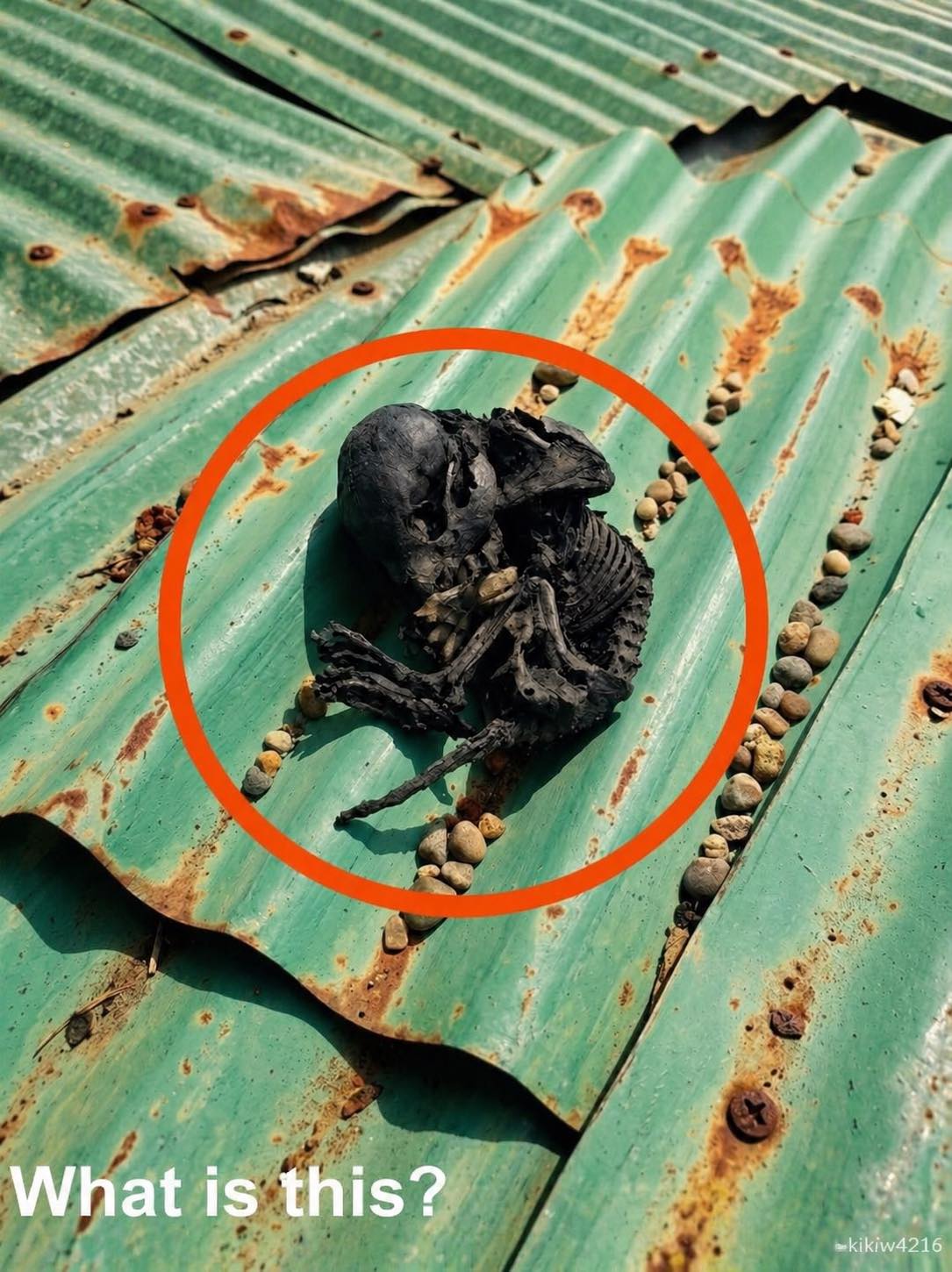
At first glance, the object might appear almost otherworldly, especially to someone encountering it unexpectedly. Its proportions seem unusual, its surface texture uneven and hardened, and its overall shape vaguely humanoid to an untrained eye. This ambiguity is what often fuels unease. The human brain is wired to recognize patterns—especially faces and bodies—so when something partially resembles those forms but doesn’t fully align, it can create a sense of discomfort or even dread. However, stepping back and examining the structure more analytically begins to reveal more familiar biological clues. The presence of a small skull-like structure, thin rib-like bones, and elongated limbs suggests that it is not something supernatural, but rather the remains of a once-living creature. The apparent “skin” clinging to the bones is likely dried tissue that has undergone a natural preservation process, giving it that dark, almost leathery appearance.
One of the most plausible explanations for such a find is natural mummification. Unlike the intentional mummification practices seen in ancient cultures, natural mummification occurs when environmental conditions slow down or halt the decomposition process. In this case, a metal roof provides an ideal setting. During the day, it can become extremely hot under direct sunlight, effectively dehydrating any organic material left on its surface. At night, the temperature may drop, but the dryness remains. Over time, this repeated cycle of heat and exposure can cause a small animal’s body to dry out completely before bacteria have a chance to break it down. The result is a preserved, shrunken version of the original organism, with skin and sometimes even feathers or fur still intact. This process is not uncommon in arid or exposed environments, though it can be startling when encountered unexpectedly.
As for the identity of the creature itself, the skeletal features provide important hints. The shape of the head and what appears to be a beak-like structure strongly suggest that it may have been a small bird. Birds are particularly susceptible to ending up in unusual places, especially rooftops, where they may land, rest, or become disoriented. Injuries, illness, or extreme weather conditions can sometimes lead to their death in such locations. Once there, their lightweight bodies are less likely to be disturbed compared to larger animals, allowing the mummification process to occur undisturbed. In some cases, the remaining feathers may decay or detach, leaving behind a more skeletal appearance that can make identification more difficult. To someone unfamiliar with avian anatomy, the exposed rib cage and limb structure might look unusual or even alien, further adding to the mystery.
