
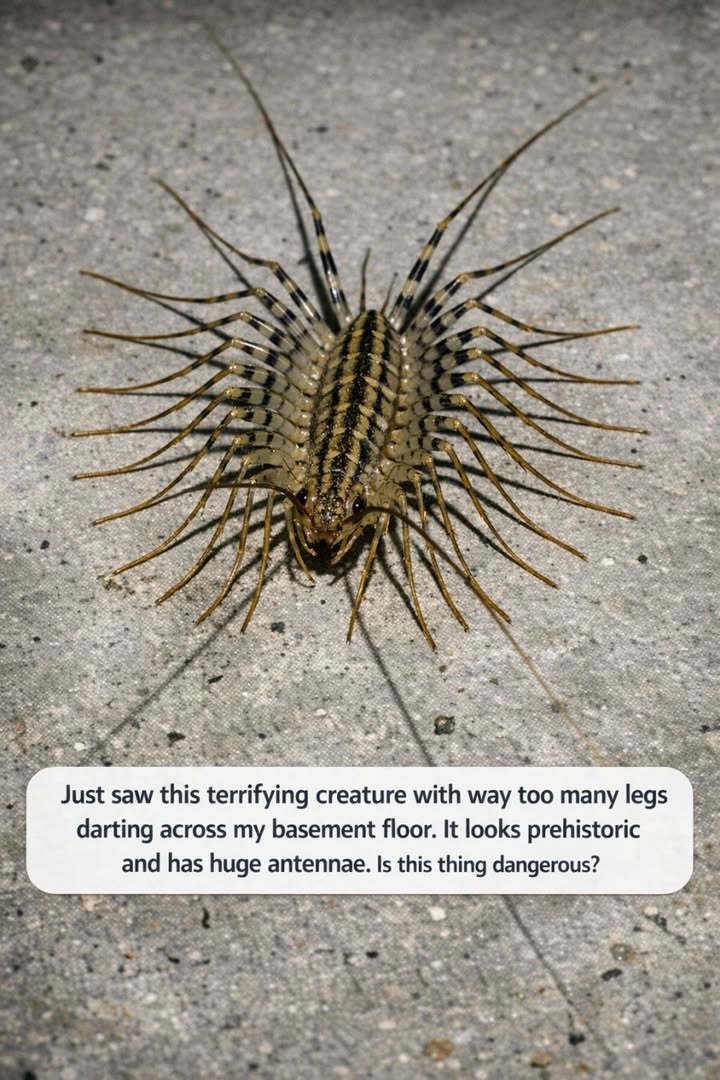
The body of an adult house centipede is typically one to one and a half inches in length — not especially large by the standards of household arthropods — and is yellowish-gray in color with three dark longitudinal stripes running from head to tail. But the body measurement tells only part of the story, because the house centipede carries 15 pairs of long, banded legs that extend outward and give it an apparent size of three to four inches total. The legs of the last pair, particularly in females, are nearly twice the length of the body, and the antennae at the front are similarly outsized. The creature thus presents itself to any observer as considerably larger than it technically is — a visual illusion produced by proportion rather than actual mass. The rear legs also have a specific function beyond locomotion: they serve as sensory appendages and closely resemble the antennae at the front, giving the house centipede what entomologists call automimicry — it is genuinely difficult to tell, at a glance, which end is which. This is a deliberate evolutionary adaptation that makes it harder for predators to identify and strike the vulnerable head.
Why It Moves the Way It Does
The speed is not your imagination. A house centipede in motion can reach approximately 0.4 meters per second — about 1.3 feet per second — which is genuinely fast for a creature of its size, and which produces that unsettling liquid-fast impression of something moving in the wrong way at the wrong speed for what it appears to be. The legs provide this speed advantage directly: all 30 of them move in coordinated waves that give the centipede both traction and agility across almost any surface. It can run across floors, up walls, and along ceilings with equal facility, and it can change direction with a suddenness that makes tracking its movement very difficult. A 1902 USDA entomology report described the house centipede as often seeming to dart directly at the humans in a room — an observation still accurate today — though the intent is not aggression. The centipede is simply running toward the nearest available cover, which frequently happens to be in the direction of the startled person who just turned on the light.
