
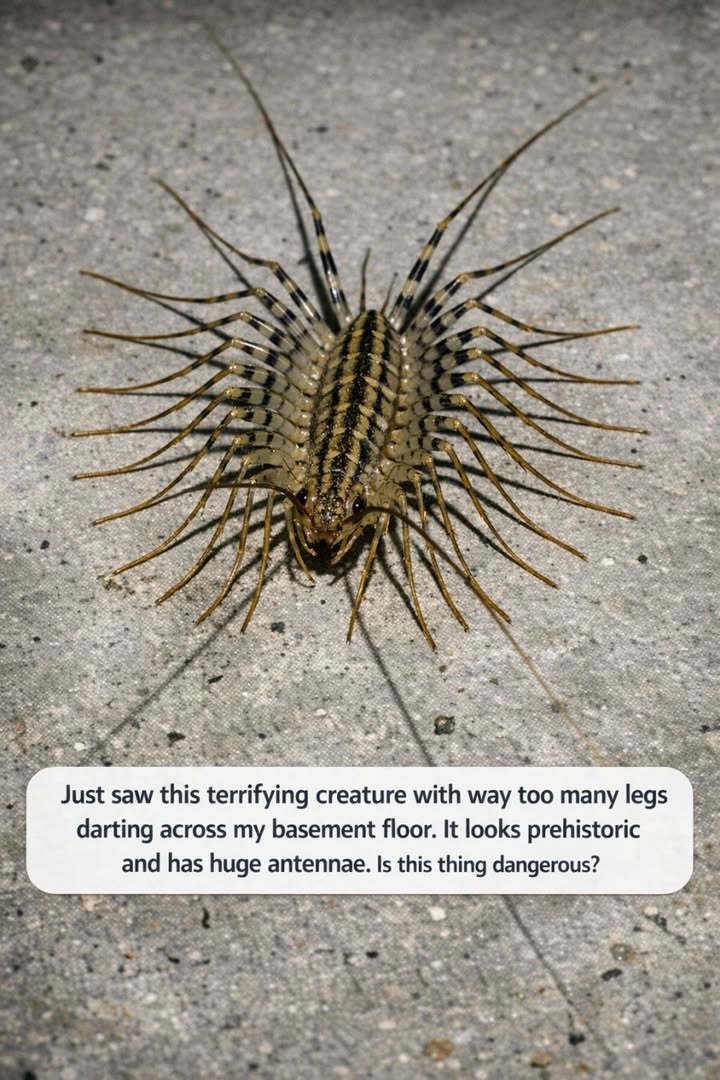
Yes and technically yes — but the practical answer to the danger question remains no. House centipedes are venomous animals. They possess a specialized pair of appendages at the front of the body called forcipules — modified legs that function as venom-delivering pincers, used to subdue their prey. In hunting, they inject venom by stinging smaller insects and arthropods, then wrap their legs around the prey and wait for the venom to take effect before feeding. This is how a creature of their size manages to hunt and kill spiders, cockroaches, silverfish, bedbugs, ants, termites, flies, and other household arthropods considerably larger or better-armored than themselves.
The question of whether they can deliver a meaningful bite to a human is more complicated. Technically, a house centipede that is cornered, handled roughly, or otherwise provoked can attempt to sting a human. In practice, this almost never happens — the centipede's first and strongly preferred response to human contact is to run away, and it is far more interested in escaping than in fighting. In the rare cases where a bite does occur, the forcipules of most house centipedes struggle to penetrate adult human skin, particularly on thicker-skinned areas of the body. If penetration does occur, the result is typically a mild, localized pain and redness similar to a bee sting, which resolves without treatment within a few hours. There are no documented cases of serious illness resulting from a house centipede bite in a healthy person. The short version: do not handle them, and they will not bite you.
What It Is Actually Doing in Your Basement
House centipedes are predators, and your basement is a hunting ground. They are nocturnal — most active at night or in the dark — and they use their exceptionally sensitive antennae to detect prey through smell, vibration, and touch rather than primarily through sight, despite having well-developed compound eyes by arthropod standards. When a house centipede detects prey, it approaches cautiously, then either springs onto the target or uses its legs in a technique that researchers describe as "lassoing" — rapidly enveloping the prey in an encirclement of limbs — before delivering a venomous sting. It can and does hunt prey considerably larger than itself, including wasps, which it stalks carefully, stings, retreats from, and then returns to consume once the venom has taken effect.
