
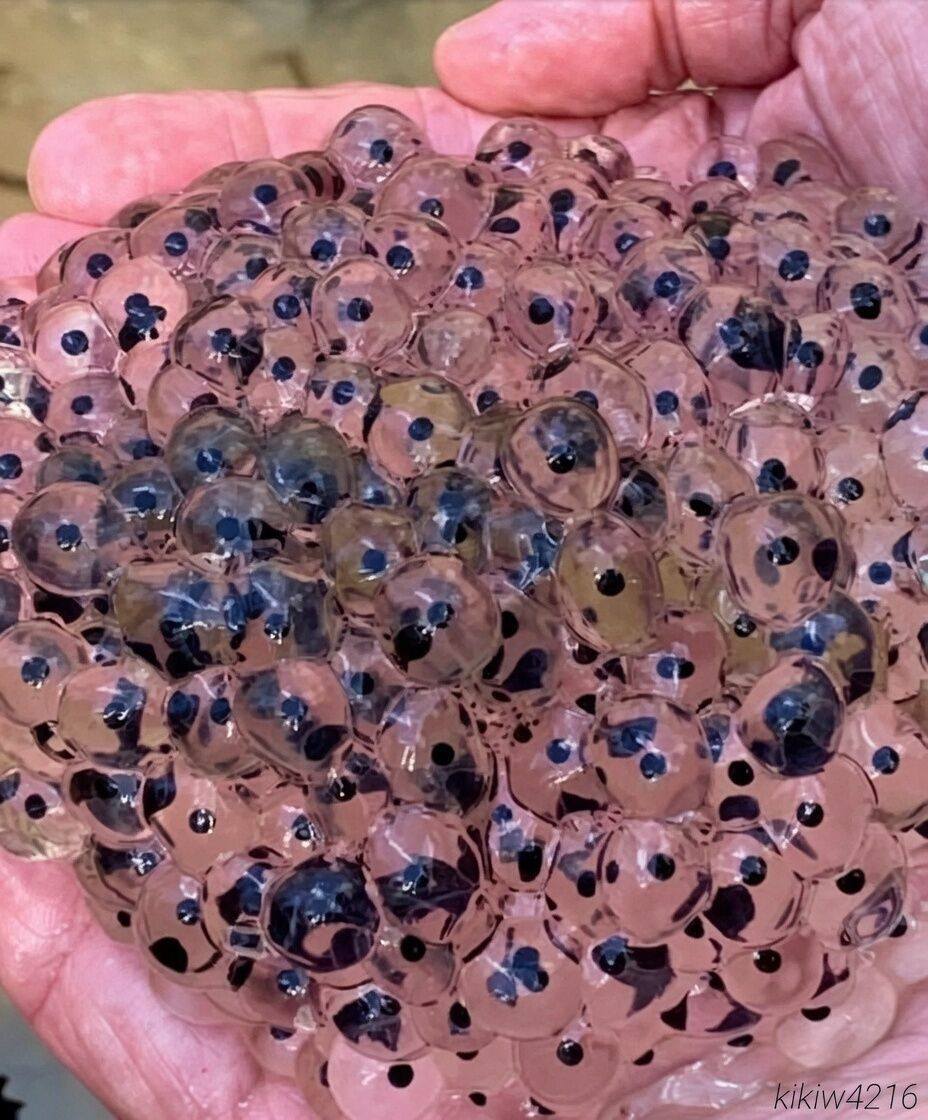
At first glance, the so-called “eyeball eggs” appear almost too strange to belong to the natural world. Resting in a human palm or floating gently in shallow water, these translucent, gelatinous spheres—each containing a dark, pupil-like center—look more like something crafted by a surreal artist than a biological reality. Yet these mesmerizing clusters are entirely natural, representing one of the most fascinating reproductive strategies found in amphibians, particularly species such as the Southern leopard frog.
The nickname “eyeball eggs” comes from the striking visual illusion created by the embryos inside each egg. Suspended within a clear jelly matrix, the developing embryo appears as a dark central spot, often resembling a tiny black eye staring outward. This uncanny resemblance has made these egg masses a viral sensation online, captivating viewers with a mix of curiosity, wonder, and mild unease.
A Closer Look at the Structure
Each of these spheres is not simply an egg but a highly specialized biological capsule. The outer layer consists of a gelatinous coating composed primarily of water, proteins, and mucopolysaccharides. This jelly serves as a multifunctional shield, protecting the embryo during one of the most vulnerable stages of its life.
Unlike bird or reptile eggs, amphibian eggs lack a hard shell. Instead, they rely on this flexible, hydrated barrier to maintain internal stability while allowing interaction with the surrounding environment. Oxygen can diffuse through the jelly, reaching the embryo, while waste products are expelled outward.
The transparency of the jelly is not accidental—it allows sunlight to penetrate, which can help regulate temperature and support early development. At the same time, the thickness of the coating provides a buffer against physical damage, dehydration, and microbial threats.
When grouped together, these eggs form dense clusters, often containing hundreds or even thousands of individual embryos. This collective arrangement enhances survival through sheer numbers, a strategy commonly referred to as “predator saturation.” Even if some eggs are consumed, many others remain to continue developing.
Why Do They Look Like Eyes?
The defining feature of these eggs—the dark, eye-like center—is the embryo itself. In early developmental stages, amphibian embryos exhibit strong pigmentation on their dorsal (upper) side. This dark coloration serves a functional purpose.
Known as countershading, this pigmentation helps camouflage the embryo in its aquatic environment. From above, the dark surface blends with the murky water or pond bottom, making it harder for predators such as birds to spot. From below, the lighter underside blends with the brighter surface light, offering protection from aquatic predators.
As the embryo develops, this pigmentation becomes more pronounced, intensifying the “eyeball” illusion. The brain and eye structures are among the earliest features to form, contributing to the appearance of a distinct central “pupil.”
This visual effect is not an evolutionary adaptation intended to mimic eyes; rather, it is a coincidental outcome of developmental biology. Still, the result is undeniably striking—an example of how natural processes can produce forms that resonate deeply with human perception.
The Role of the Jelly Matrix
The gelatinous mass surrounding each egg plays several critical roles beyond simple protection. One of its primary functions is to retain moisture, ensuring that the embryo does not dry out if water levels fluctuate.
In temporary or shallow wetlands, water conditions can change rapidly. The jelly helps buffer against these changes, maintaining a stable microenvironment around each embryo. It can also absorb and retain heat, slightly elevating the temperature inside the egg mass compared to the surrounding water, which may accelerate development.
Additionally, the slippery texture of the jelly makes it difficult for many predators to grasp or consume the eggs efficiently. Some studies suggest that certain amphibian egg masses may even contain compounds that deter microbial growth or make them less palatable to predators.
The jelly also expands after being laid, absorbing water and increasing in size. This swelling creates the characteristic bouncy, tapioca-like clusters often observed in ponds and wetlands.
