
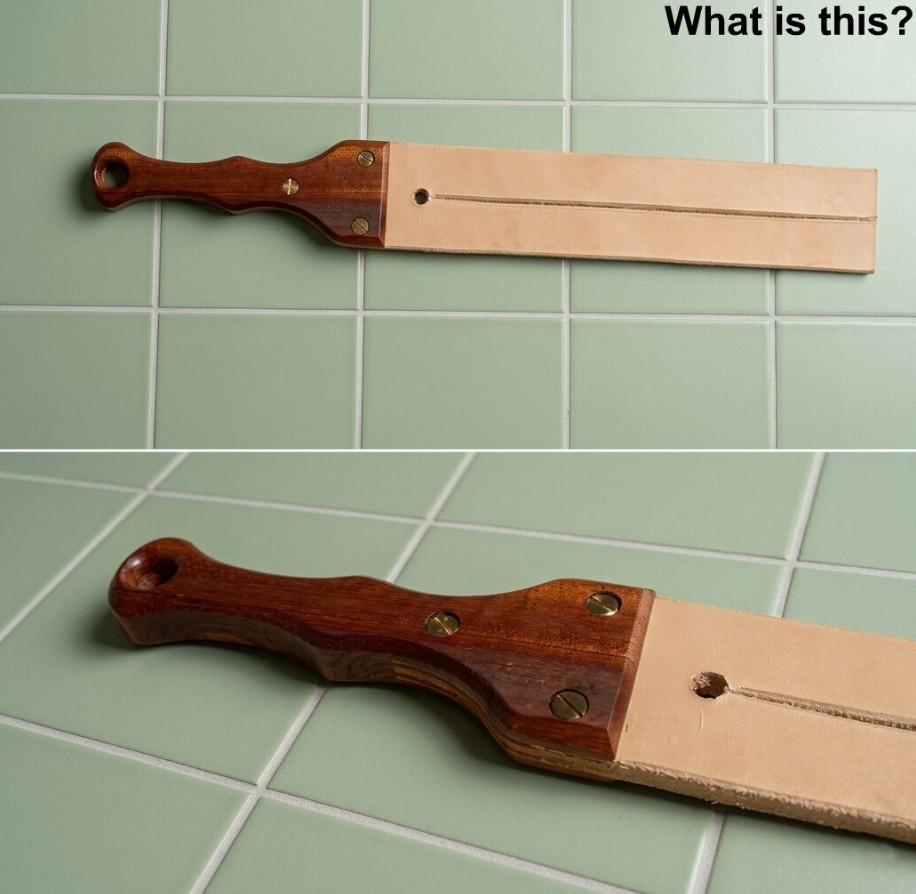
He took one look at it, paused for a moment, and then smiled like he had just been handed a small piece of his youth.
“Back in the day,” he said, “everyone had one of those.”
That was the moment everything shifted.
Because it wasn’t a forgotten tool. It wasn’t obsolete machinery or some mysterious workshop accessory.
It was something far more elegant in its simplicity.
A Tool for Refinement, Not Cutting
What I had found was a leather strop—a traditional tool used for polishing and refining the edge of blades.
Not for cutting. Not for shaping. But for maintaining sharpness.
In a world where most tools today are replaced rather than maintained, the concept feels almost foreign. But historically, keeping a blade sharp was a skill in itself. Whether it was for cooking, crafting, shaving, or trade work, a sharp edge wasn’t just convenient—it was essential.
And the leather strop was one of the most important parts of that process.
After a blade was sharpened on a stone, it would still have microscopic imperfections along its edge. Those tiny irregularities could make the blade feel dull or less precise. The strop was used as the final step: a way to polish, align, and refine the edge to near perfection.
Instead of grinding metal away, it worked in a gentler way—smoothing and straightening the blade at a microscopic level.
How It Works
Using a leather strop is surprisingly simple, but it requires a certain rhythm and care.
The blade is drawn along the surface of the leather, typically away from the cutting edge rather than into it. This motion helps realign the microscopic teeth of the blade and polish the metal surface.
Many traditional strops also include a fine abrasive compound applied to the leather. This enhances the polishing effect, making the edge even finer and sharper.
It’s not about force. It’s about consistency.
