
Imagine losing your home, your job, and almost everything you own.
Now imagine having nowhere to go.
No apartment.
No warm bedroom.
No kitchen.
No front door to lock at night.
During the Great Depression, millions of Americans experienced poverty and unemployment on a scale that is difficult to imagine today. For many people, losing a job didn’t simply mean cutting back on luxuries. It could mean losing the ability to pay rent, buy food, or keep a roof over the family’s head.
As the economic crisis deepened, makeshift communities appeared across American cities. They became known as Hoovervilles, named after President Herbert Hoover, whom many struggling Americans blamed for the crisis.
Some people built shelters from wooden scraps, cardboard, metal, crates, and whatever other materials they could find.
But in Oakland, California, something particularly unusual happened.
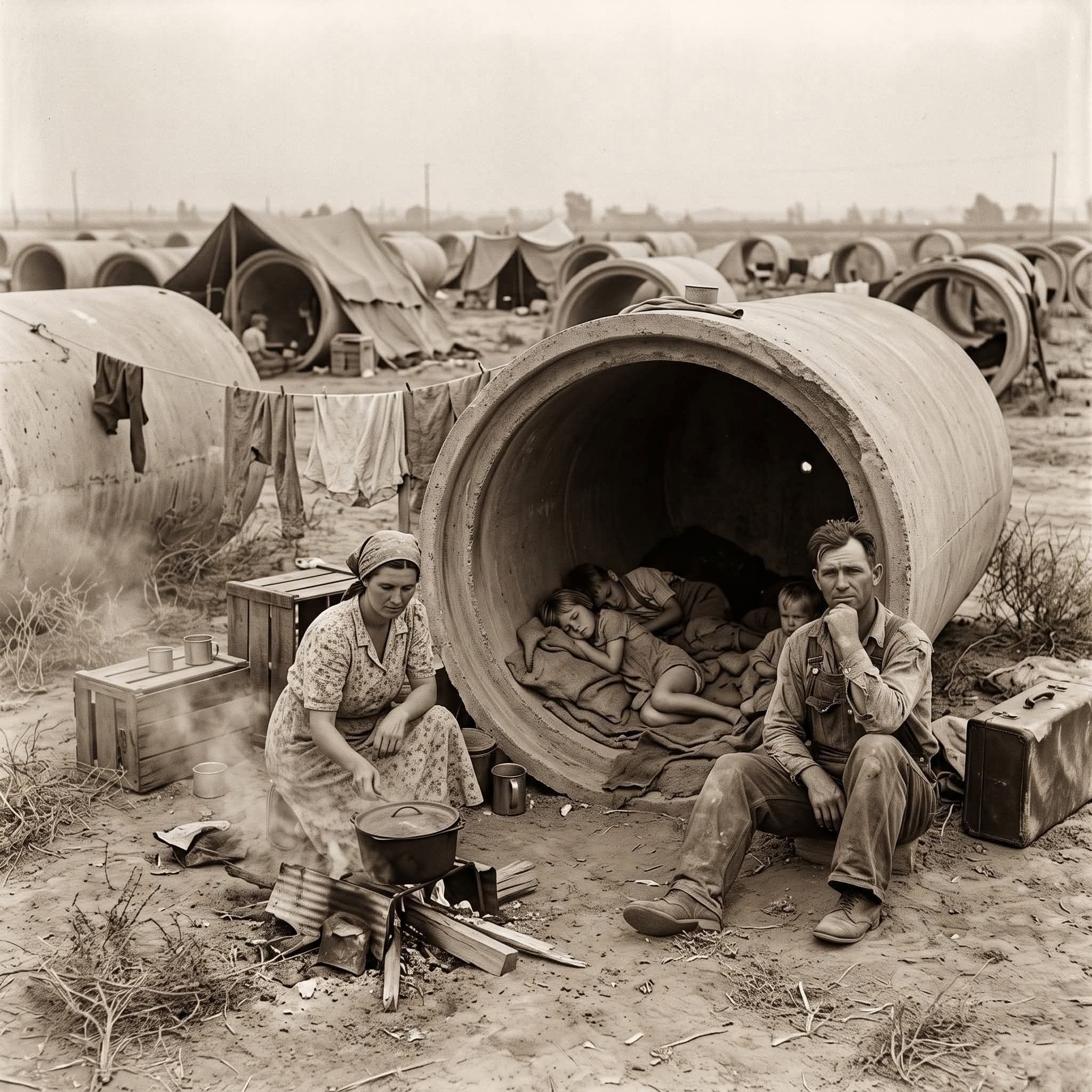
Large concrete pipes became temporary homes.
The community became known as Pipe City.
During the winter of 1932–1933, roughly 200 unemployed and homeless men lived in large surplus concrete pipes at a storage yard belonging to the American Concrete Pipe Company. The pipes were enormous enough for people to crawl inside, offering at least some protection from rain, wind, and the cold.
It was hardly a comfortable place to live.
The residents themselves reportedly referred to the settlement as “Miseryville,” while newspapers popularized the name “Pipe City.”
But there was something remarkable about the community.
These men didn’t simply occupy the pipes and disappear into the background.
They organized themselves.
Pipe City had a mayor, rules, and a system for distributing food and assistance. Dutch Jensen became the settlement’s elected mayor and helped organize the residents. Food donations and money from odd jobs were shared among the community.
Imagine waking up inside a concrete pipe and knowing that your entire community was facing the same uncertainty.
Someone might have lost a factory job.
Someone else might have traveled across the country searching for work.
Another person might have been separated from his family because he could no longer afford to support them.
The Great Depression wasn’t simply an economic statistic.
Behind every unemployment number was a real person.
And behind many of those people were families.
The nationwide housing crisis forced thousands of Americans to improvise. People slept in parks, under bridges, in abandoned buildings, in makeshift camps, and sometimes inside concrete pipes or other structures that were never intended to be homes.
For people living in these conditions, privacy was almost nonexistent.
There was no proper kitchen.
No reliable heating.
No indoor bathroom.
No comfortable bed.
And certainly no guarantee that they would still have their shelter the next day.
Yet communities like Pipe City demonstrated something important: even in extreme poverty, people could create a sense of organization and solidarity.
Residents collected food.
They looked for temporary work.
Continue reading on the next page
