
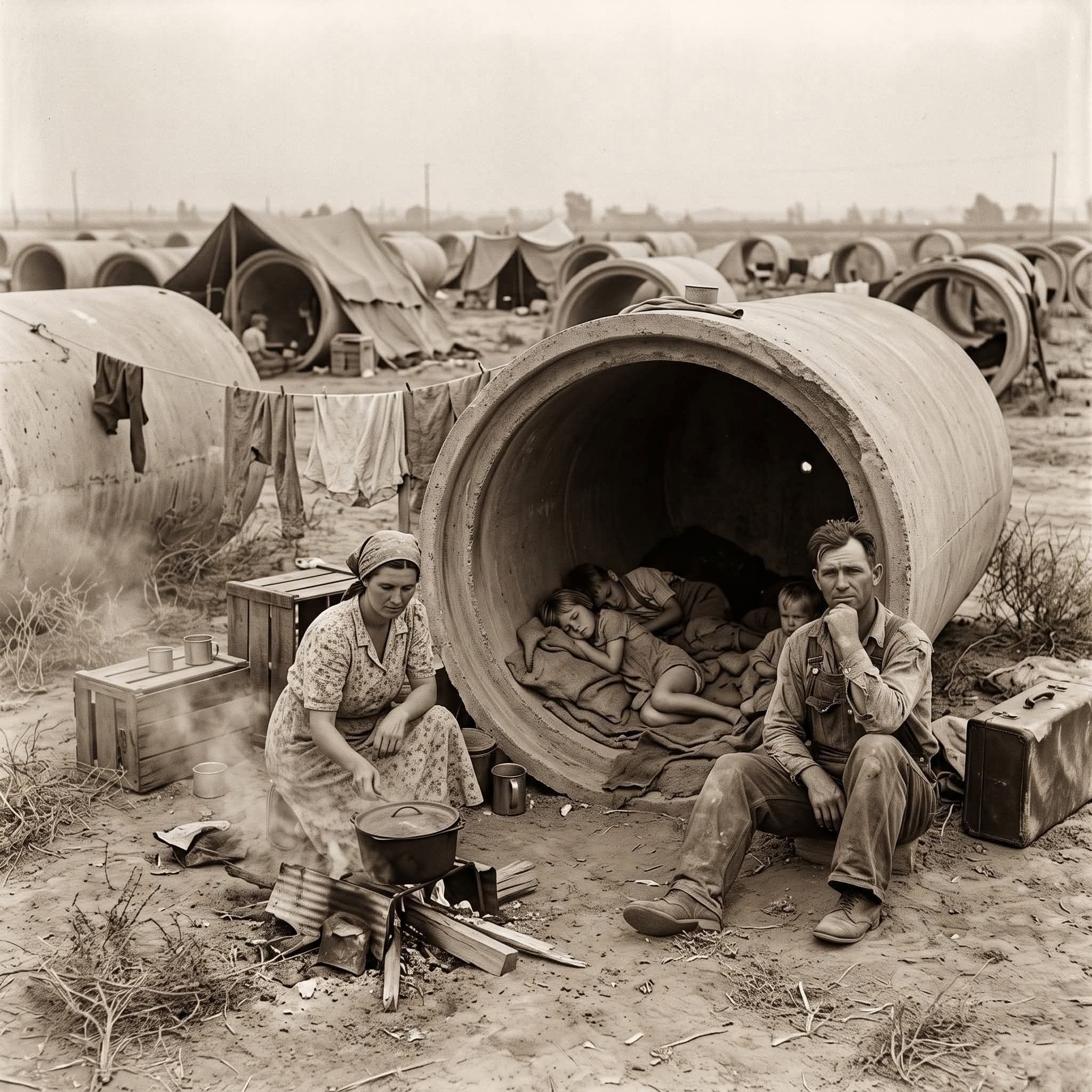
They shared what they had.
And they tried to help one another survive.
The pipes themselves were never intended to become houses.
They were industrial products waiting to be sold or transported. But during one of the darkest economic periods in American history, they became something else entirely: temporary shelters for people who had nowhere else to sleep.
The story also reveals how different homelessness looked during the Great Depression.
Today, people often imagine homelessness as something that happens to individuals, but during the Depression, unemployment and housing insecurity affected enormous numbers of ordinary working people.
A person could lose a job through circumstances completely outside their control.
A factory could close.
A farm could fail.
A business could collapse.
A family could fall behind on rent.
And suddenly, a person who had lived a relatively ordinary life could find themselves without a home.
That’s why the stories of Hoovervilles and places like Pipe City remain so powerful.
They remind us that economic disasters are ultimately human disasters.
Behind the words “unemployment,” “foreclosure,” and “poverty” were parents trying to feed their children, workers searching for jobs, and families trying to maintain some sense of dignity.
Pipe City did not last forever.
The settlement existed for only a relatively short period. By the spring of 1933, the community was coming to an end as the concrete pipes were sold. The residents had to move on and find other places to live.
But the story survived.
It became one of the unusual historical examples of how desperate people became during the Great Depression.
Today, a concrete pipe might look like nothing more than an ordinary construction material.
But nearly a century ago, some of those pipes represented something much more important.
Shelter.
A little protection from the weather.
A place where someone could close their eyes and sleep without being completely exposed to the elements.
It wasn’t a real home.
But for someone who had nowhere else to go, it could be the difference between sleeping inside a structure and sleeping completely outdoors.
And perhaps the most heartbreaking part of the story is that the people who lived there were not looking for luxury.
They were looking for work.
They wanted a chance to earn money, rent a room, feed themselves, and return to something resembling a normal life.
Their circumstances had simply made normal life temporarily impossible.
The story of Pipe City is therefore more than a strange historical curiosity.
It’s a reminder of how quickly economic circumstances can change people’s lives—and how creative human beings can become when survival depends on making something out of almost nothing.
A concrete pipe was never designed to be a home.
But during the Great Depression, it became one for hundreds of desperate people.
And that simple fact tells us something unforgettable about that era:
When people have nowhere else to go, even the most unlikely place can become a shelter.
