
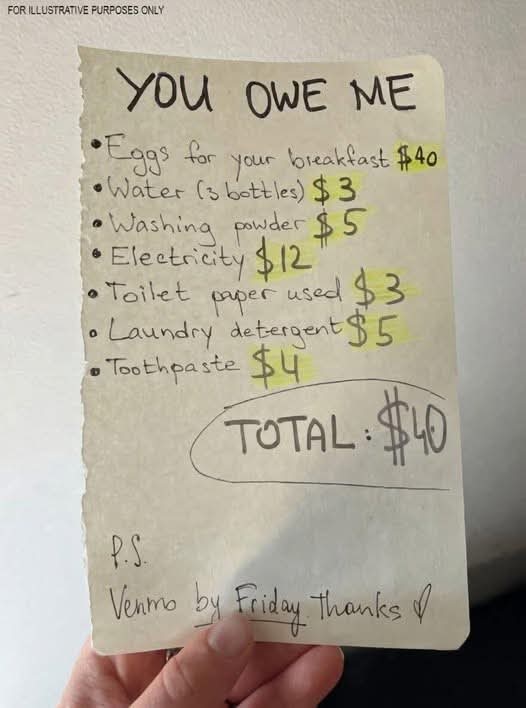
The next morning, Lila received a message from me.
It wasn’t a Venmo payment.
It was a photograph.
A photograph of a handwritten note.
At the top, I had written:
YOU OWE ME
Below it was a list.
Babysitting Oliver — 48 hours: $0
Preparing his meals: $0
Cleaning up after him: $0
Driving him to the park: $0
Reading bedtime stories: $0
Washing his pajamas: $0
Comforting him when he missed his mother: $0
Getting up at 2 a.m. when he had a nightmare: $0
Loving your son: PRICELESS
Then, at the bottom, I wrote:
TOTAL: $0
And underneath:
But if we’re going to start charging family for every little thing, I think we should have a complete accounting.
I didn’t send anything else.
I waited.
Ten minutes passed.
Then my phone rang.
It was Lila.
I answered.
“Hi.”
There was silence.
Finally she said:
“Did you really mean that?”
“I meant exactly what I wrote.”
“I wasn’t trying to insult you.”
“Then what were you trying to do?”
She sighed.
“I thought you were taking advantage.”
I was stunned.
“Taking advantage of what?”
“Of us. Of our house. Of the things we pay for.”
I took a breath.
“Lila, I used some eggs. I drank some water. I took a shower. I washed a child’s pajamas. I wasn’t staying at a hotel.”
“I know.”
“Then why did you bill me?”
Another silence.
Then her voice changed.
“I don’t know.”
That answer surprised me.
I expected defensiveness.
Instead, she sounded tired.
Very tired.
She finally admitted that she’d been under enormous financial pressure.
The spa trip she’d mentioned wasn’t exactly the carefree weekend she’d made it sound like.
She and Lucas had been arguing about money.
Their bills had increased.
They had been trying to save for Oliver’s preschool.
And, apparently, Lila had become so obsessed with controlling every expense that she’d started treating ordinary family interactions like transactions.
“I thought if I didn’t keep track of everything,” she whispered, “we’d lose control.”
I sat down.
“That doesn’t make what you did okay.”
“I know.”
“But you could have talked to me.”
“I was embarrassed.”
That sentence changed the conversation.
For the first time, I understood that the forty-dollar note hadn’t really been about forty dollars.
It had been about fear.
Fear of money.
Fear of losing control.
Fear of needing help.
But understanding someone doesn’t mean pretending their behavior was acceptable.
So I told her that.
“I understand why you’re stressed,” I said. “But Oliver isn’t a bill. And I’m not a customer.”
She started crying.
“I know.”
“I don’t want money from you. I don’t want anything from you.”
“What do you want?”
I thought for a moment.
“Respect.”
She was quiet.
“And maybe,” I added, “a simple thank-you once in a while.”
“I can do that.”
—
Two weeks later, Lila came to my house alone.
She stood at the front door holding an envelope.
“I brought something.”
I opened it.
Inside was forty dollars.
I laughed.
“What is this?”
“Your bill.”
“You don’t owe me.”
“I know.”
She took a breath.
“I just wanted to return it.”
I handed the money back.
“Keep it.”
She looked confused.
“Why?”
“Because I don’t want our relationship to be about money.”
She smiled through tears.
Then she hugged me.
It was the first real hug we’d ever shared.
A few minutes later, Oliver burst through the door.
“Nana!”
He ran straight into my arms.
Lila watched us.
Then she said something I’ll never forget.
“Thank you for loving him.”
I looked at her.
“That was never something you needed to pay for.”
She nodded.
“I know that now.”
And that little handwritten bill?
I never threw it away.
I kept it in a drawer—not because I was still angry, but because it reminded me of something important.
Sometimes people behave badly because they’re hurting.
That doesn’t excuse what they do.
But sometimes, behind an ugly action, there’s a fear that nobody else can see.
And sometimes the most powerful response isn’t revenge.
It’s a boundary, a little honesty, and the courage to say:
“We’re family. Let’s stop keeping score.”
