
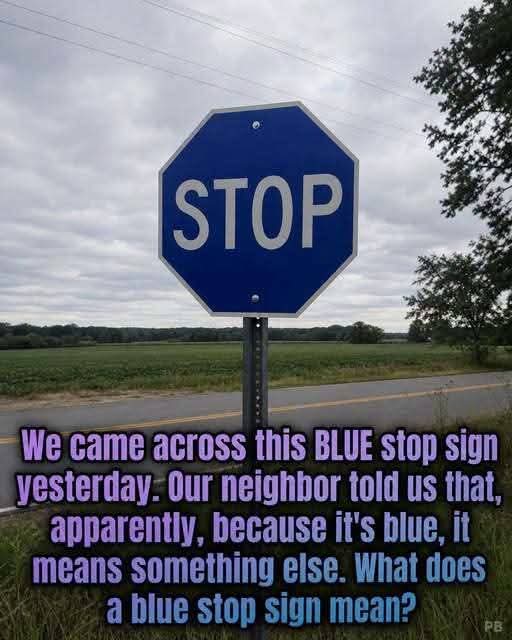
The Meaning Behind a Blue Stop Sign: What Does It Really Mean?
Most drivers have spent their entire lives seeing the same familiar road sign: an eight-sided red sign with the word STOP written in white.
There is rarely any confusion when we see it. The red color, the octagonal shape, and the word itself immediately tell us what to do.
But what happens when that familiar stop sign is blue?
For many drivers, seeing a blue stop sign for the first time can be surprisingly confusing. It looks almost exactly like a normal stop sign, yet the color is completely different.
Is it a mistake?
Does it have a different meaning?
And most importantly, are you actually supposed to stop?
Why Are Stop Signs Usually Red?
The red stop sign has become one of the most recognizable symbols in road safety.
Red is strongly associated with danger, warning, prohibition, and the need for immediate attention. Using the same color and shape consistently allows drivers to recognize the sign quickly, even before they have time to read the word.
In the United States, official stop signs on public roads follow specific standards governing their shape, color, size, and appearance.
That’s why a blue version immediately looks unusual.
So What Is a Blue Stop Sign?
A blue stop sign is generally not the standard official stop sign used on public roads in the United States.
Instead, blue stop signs can be found in places such as:
– Private residential communities
– Apartment complexes
– Parking lots
– Business properties
– Industrial facilities
– Private campuses
– Resorts and other privately controlled areas
Private property owners may use nonstandard signs to control traffic within their property.
The sign may still be intended to tell drivers to stop, even though it doesn’t have exactly the same status as a government-installed traffic-control sign on a public road.
Does Blue Mean You Can Ignore It?
Absolutely not.
If you encounter a blue stop sign, the safest response is to stop.
Even if the sign is being used on private property and doesn’t have the same legal authority as a standard public-road stop sign, there may be a very good safety reason for it being there.
Perhaps vehicles have limited visibility.
Perhaps pedestrians regularly cross the area.
Maybe there is a hidden driveway, a blind corner, a steep drop, or heavy traffic coming from another direction.
Ignoring the sign simply because its color is unusual can create a dangerous situation.
Continue reading on the next page
