
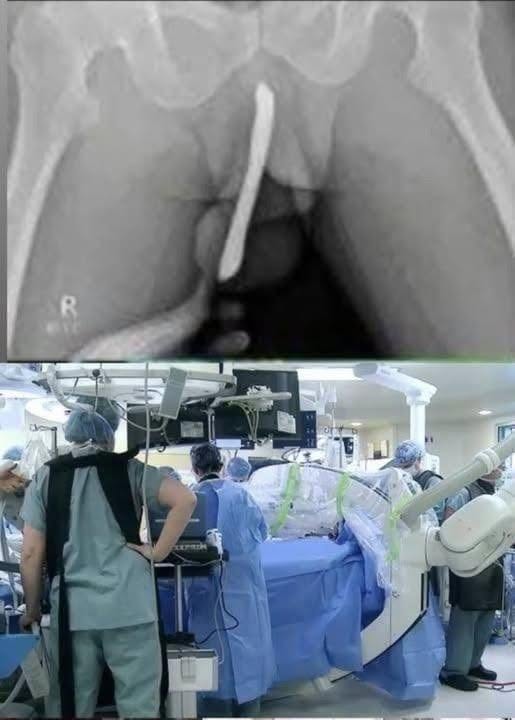
The combined photograph can therefore be interpreted as more than a technical image.
It represents the convergence of several areas of medicine:
Imaging provides visualization.
Engineering provides sophisticated devices and machines.
Medicine provides diagnostic and therapeutic knowledge.
Surgery and procedural expertise provide the technical ability to manipulate instruments safely.
Nursing and allied health professionals provide monitoring, preparation, coordination, and patient care.
Anesthesia and critical-care expertise help keep patients comfortable and safe when sedation or anesthesia is required.
All of these elements must work together.
The result is a healthcare environment in which a physician can diagnose, navigate, and treat using information obtained in real time.
Why These Procedures Are Important for Patients
From a patient's perspective, the technology may appear intimidating.
Large machines, multiple monitors, protective clothing, sterile drapes, and numerous members of the medical team can make a procedure room seem overwhelming.
But each component serves a purpose.
The imaging equipment helps the physician see.
The monitors help the team watch the patient's condition.
Sterile equipment reduces infection risk.
Protective equipment helps staff work safely.
Specialized instruments allow physicians to perform delicate tasks through small access points.
The team itself provides the clinical expertise required to bring everything together.
For patients, understanding this process can make the environment less mysterious.
Rather than seeing a room full of machines, it can be helpful to understand that the equipment forms part of an integrated system designed around one objective: providing safe and effective care.
The Future of Minimally Invasive Medicine
The trend toward less invasive treatment is likely to continue.
Future procedure rooms may feature more advanced three-dimensional imaging, improved navigation systems, smarter software, smaller instruments, and greater integration between different imaging technologies.
Miniaturization could allow physicians to access increasingly difficult anatomical locations.
Improved imaging may provide clearer visualization with lower radiation exposure.
Artificial intelligence may assist with image interpretation and procedure planning.
Robotic systems may offer new approaches to instrument control.
At the same time, the central role of medical professionals will remain.
Technology can show an anatomical structure, but a physician must understand what that structure means. A computer can provide measurements, but a clinician must determine their significance. A navigation system can help guide an instrument, but a trained professional must decide where that instrument should go.
The future will therefore likely be defined not by technology replacing clinicians, but by technology augmenting their capabilities.
Conclusion
The photograph of the fluoroscopic image and modern procedure room offers a fascinating window into contemporary medicine.
The upper image demonstrates the ability to visualize a medical instrument inside the body using X-ray-based imaging. The lower image shows the complex clinical environment in which such procedures are performed, surrounded by specialized equipment and a multidisciplinary healthcare team.
Together, they illustrate one of the most important trends in modern healthcare: the movement toward precise, image-guided, minimally invasive treatment.
These techniques can allow physicians to reach internal structures through relatively small access points, potentially reducing tissue disruption and recovery time for appropriately selected patients. Fluoroscopy and other imaging technologies provide real-time information, while specialized instruments allow doctors to perform increasingly sophisticated interventions.
Yet the true achievement is not the machine itself.
The real achievement is the integration of technology with human expertise.
Behind every image is a physician interpreting anatomy. Behind every instrument is a trained professional making decisions. Behind every procedure is a team working to protect the patient's safety.
As medical technology continues to advance, image-guided procedures will likely become even more precise, personalized, and sophisticated. The procedure room of the future may look very different from today's operating theatre, but its fundamental purpose will remain unchanged: combining knowledge, technology, and teamwork to provide the best possible care for the patient.
The image therefore represents more than an X-ray and a hospital room. It represents a broader transformation in medicine—from procedures that once required extensive surgical exposure toward treatments that can sometimes be performed with extraordinary precision through remarkably small pathways.
That transformation is one of the clearest examples of how modern healthcare continues to push the boundaries of what is possible.
