
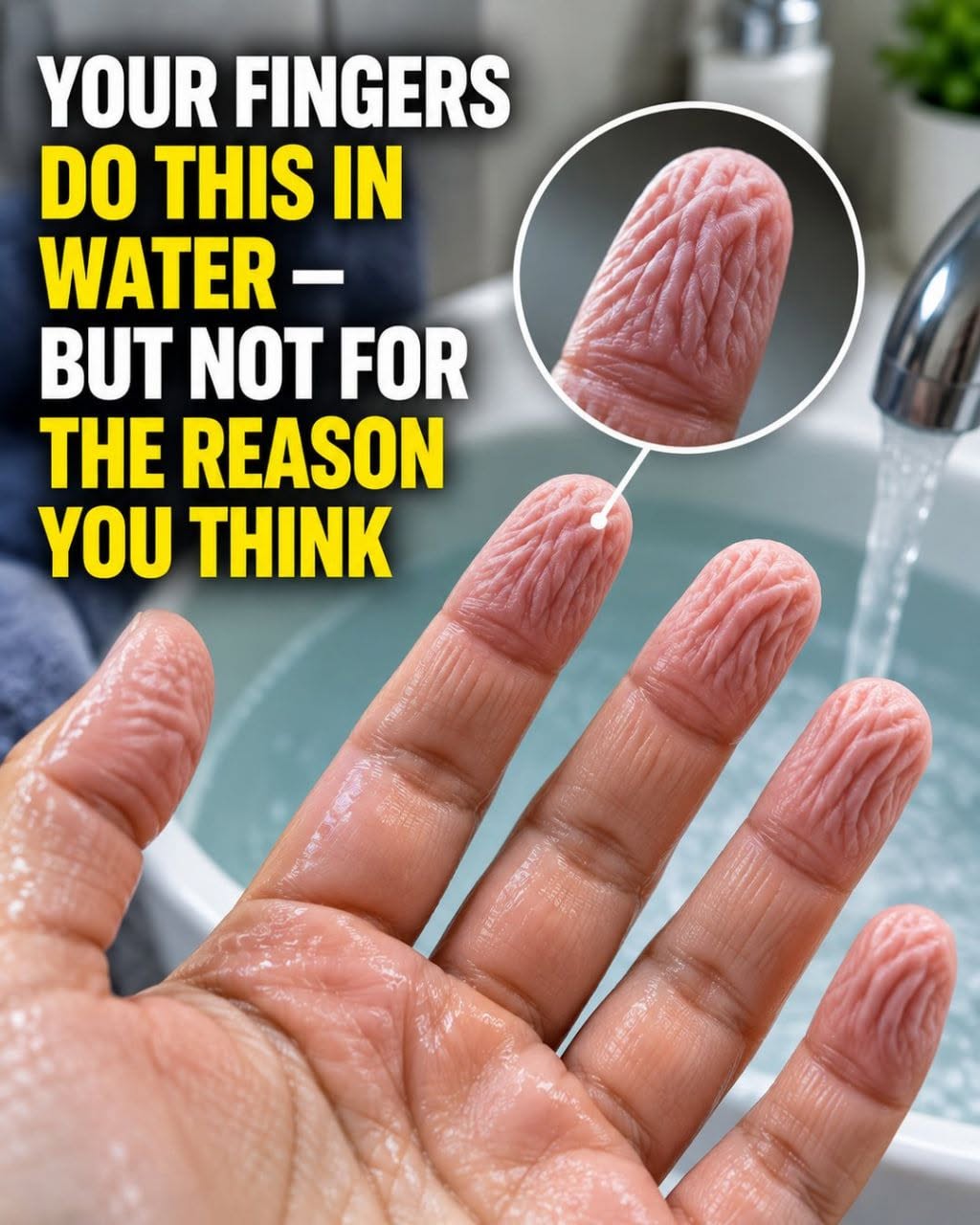
Why We Call Them “Pruney” Fingers
The informal expression comes from the resemblance between wrinkled wet fingertips and the folded surface of dried fruit such as prunes.
It is not a medical term, but it has become an instantly recognizable description in everyday English.
The appearance may be simple, but the mechanism beneath it is considerably more sophisticated than the nickname suggests.
Your fingertips are also packed with sensory structures, which makes what happens in this tiny area of skin even more remarkable.
Your Fingertips Are Highly Sensitive
Fingertips are among the most sensitive areas of the body.
They contain a dense collection of sensory receptors that help the nervous system detect pressure, vibration, texture, and other forms of touch.
This sensitivity allows humans to perform remarkably precise tasks.
Buttoning a shirt, typing, picking up a coin, turning a tiny screw, or feeling the texture of fabric all depend partly on detailed sensory information coming from the fingers.
Fingerprints and Water Wrinkles Are Not the Same Thing
Fingerprints are permanent ridge patterns established before birth.
Water-induced wrinkles are temporary folds that appear after prolonged immersion.
Your fingerprints do not disappear simply because your fingertips become wrinkled.
The two patterns can overlap visually, which is one reason a close-up photograph of a wet fingertip can look so complex.
Do Your Fingerprints Change After a Bath?
The underlying fingerprint pattern remains.
Temporary swelling and wrinkling can alter the surface appearance, but once the fingers dry and return to their normal condition, the familiar ridge pattern remains.
This highlights the difference between permanent anatomical structures and temporary physiological responses.
Why Doesn’t Your Entire Hand Wrinkle the Same Way?
The palm can show changes after prolonged water exposure, but the dramatic “pruney” appearance is particularly obvious on the fingertips.
Skin differs significantly across the body.
The thick, hairless skin on the palms and soles has specialized characteristics suited to gripping, touching, and bearing mechanical stress.
So it should not be surprising that it responds differently from the thinner skin covering areas such as the forearm.
What Does This Tell Us About the Human Body?
Perhaps the most interesting lesson has little to do with wrinkles themselves.
The phenomenon shows how difficult it can be to explain the body based solely on appearance.
The obvious explanation — “the skin just absorbs water” — sounds perfectly reasonable.
Only closer investigation reveals the hidden role of nerves and blood vessels.
The same principle applies throughout human physiology: many ordinary things happening on the surface are controlled by surprisingly complex systems underneath.
Other Automatic Responses You Rarely Think About
Your pupils change size depending on light conditions.
