
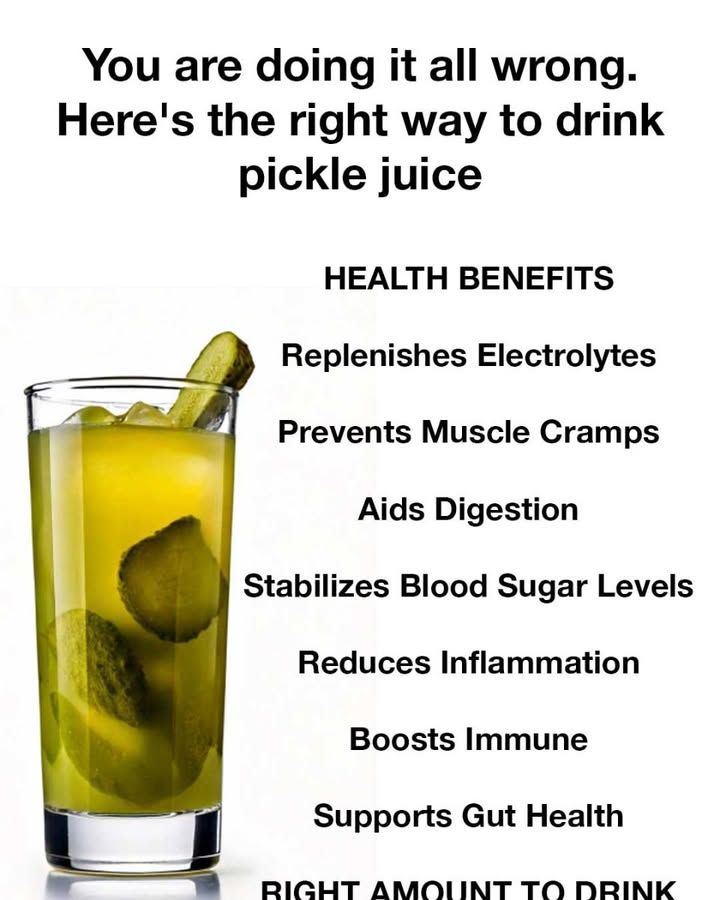
How to Drink It Correctly
The right approach depends on what you are trying to achieve, but several principles apply across the board. Start with a small amount — one to two tablespoons, or roughly one ounce — especially if you are not accustomed to it. Registered dietitian Bri Bell notes that because pickle juice nutritional information on store jars is based on the pickle itself rather than the juice, it is difficult to know exactly how much sodium you are getting per ounce of liquid, making it important to start conservatively and observe how your body responds.
For muscle cramp relief, drink a small shot — about one-third of a cup — quickly when a cramp occurs during or after exercise. For blood sugar management, consume one to two tablespoons before a meal that contains carbohydrates. For post-workout electrolyte replenishment, a one to two ounce shot taken immediately after exercise is a practical approach. For gut health from fermented pickle juice, one to two tablespoons daily as a consistent addition to your routine is a reasonable starting point, though consistency over time matters more than the exact amount.
Mixing pickle juice with water reduces the intensity of the flavor and the sodium concentration, which can make it easier to drink and more appropriate for everyday use. Using it as a salad dressing component, marinade base, or ingredient in sauces and dips is another practical way to incorporate it regularly without drinking it straight.
Who Should Avoid It
Pickle juice is not appropriate for everyone. Its high sodium content makes it unsuitable for people with hypertension, heart disease, kidney disease, or liver disease, or for anyone on a sodium-restricted diet. Registered dietitians at Ohio State University's medical center note that for many people, the sodium content of pickle juice means its risks outweigh the benefits — particularly given that there are lower-sodium ways to obtain probiotics and most other benefits associated with the juice. People with stomach ulcers or significant acid reflux should also approach it with caution, as the high acidity of pickle juice can aggravate these conditions. If you have any existing health conditions, it is worth discussing with a healthcare provider before making pickle juice a regular part of your diet.
For most healthy people, a small amount of the right kind of pickle juice, consumed at the right time for the right reason, is a genuinely useful addition to their routine. The key is understanding what you are actually drinking and what it can and cannot do — and not pouring that jar of brine down the drain quite so quickly.
