
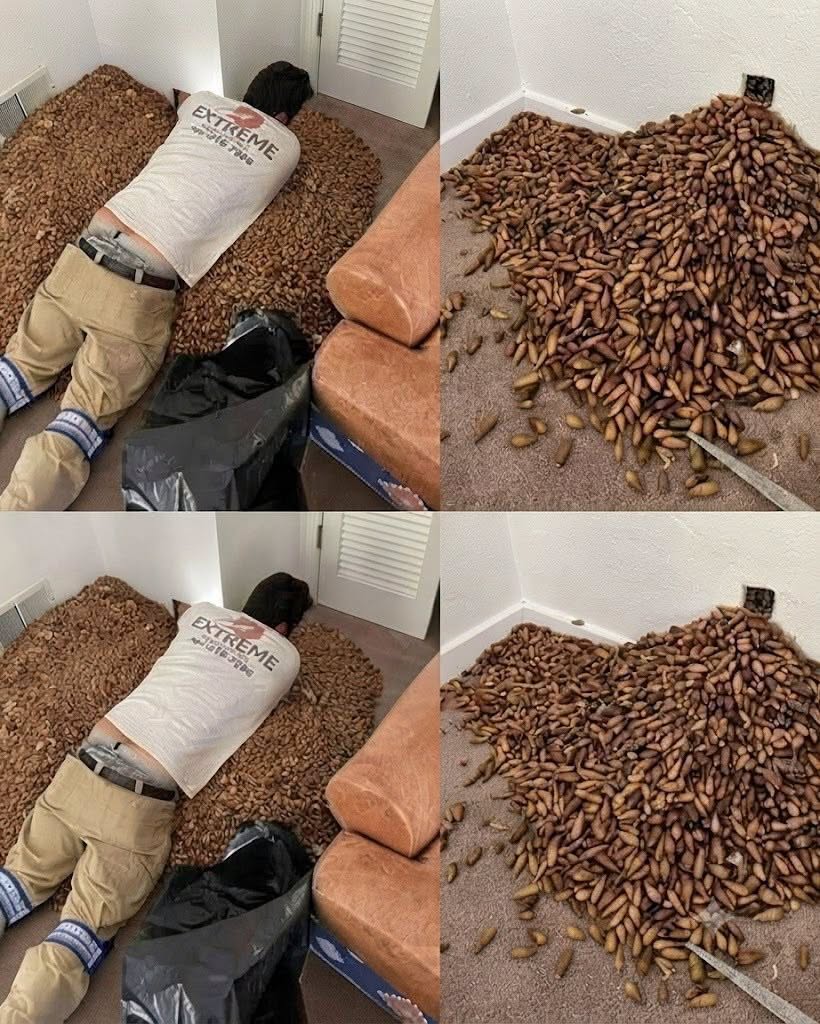
Instead of remaining neatly stored near the entrance, many of the acorns fell downward into the empty spaces inside the wall.
The woodpecker could continue returning to the same area without necessarily realizing that her carefully collected food was disappearing deeper into the structure.
One acorn became dozens.
Dozens became hundreds.
And eventually, hundreds became hundreds of pounds.
The Bird Was Working Hard—But Her Effort Was Going to Waste
There's something almost heartbreaking about the story when you look at it from the bird's perspective.
The woodpecker had clearly been busy.
She had found a source of food, transported the acorns, and repeatedly returned to store them.
From her perspective, she was building up a valuable reserve.
But because the acorns were falling into inaccessible areas of the house, the stash wasn't necessarily serving its intended purpose.
Her hard work was effectively disappearing into the walls.
Every trip represented effort.
Every acorn represented another piece of food she had collected.
Yet the food was accumulating somewhere she couldn't easily retrieve it.
An Unusual Pest-Control Job
For Castro, this wasn't simply about removing a large amount of material from a wall.
The situation also involved an animal that wasn't intentionally trying to damage the homeowner's property.
The woodpecker was simply behaving according to its instincts.
That distinction mattered.
Rather than harming the bird, the pest-control team followed a humane approach.
The goal wasn't to punish or eliminate the animal.
It was to prevent the house from continuing to be used as an enormous acorn storage facility.
The Solution Was Surprisingly Simple
Once the acorns had been removed, the next step was to prevent the woodpecker from continuing to use the same openings.
