
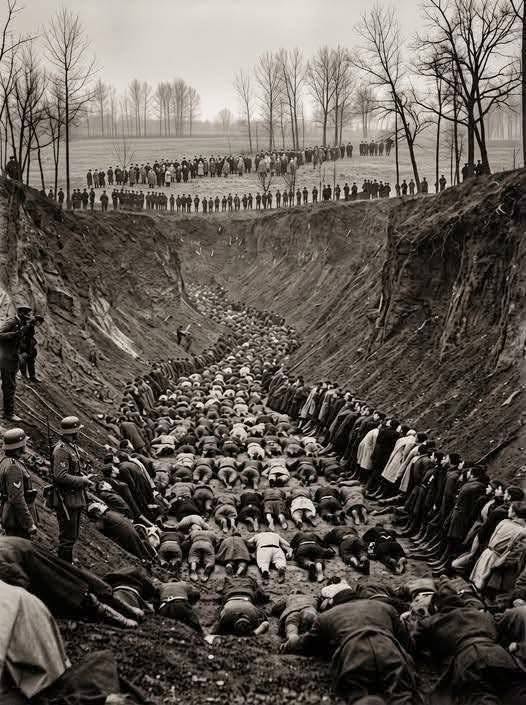
The Horror Did Not End at Babi Yar
But the massacre of September 29–30, 1941, was only the beginning of the suffering at Babi Yar. The ravine would continue to be used as a killing site throughout the German occupation of Kyiv, becoming a symbol of the wider campaign of mass murder carried out across Nazi-occupied Eastern Europe.
Some Jewish residents had survived the initial roundup by hiding, escaping the city, or finding temporary shelter with people willing to help them. But remaining hidden was extremely dangerous. German authorities and auxiliary forces continued searching for Jews who had escaped the first massacre. Those who were discovered could be arrested and taken to Babi Yar.
The victims were no longer only the people who had been gathered during those two terrible days in September.
Over the following months and years, Babi Yar became a site where different groups were murdered. Jews who were captured after the original massacre were brought there, along with Roma, Soviet prisoners of war, Ukrainian civilians, psychiatric patients, and others persecuted by the occupying authorities.
The ravine had become part of a much larger system of terror.
A City Living Under Fear
Kyiv itself had been devastated by the German occupation.
People lived under military rule, surrounded by executions, arrests, forced labor, confiscations, and the constant threat of denunciation. For Jewish survivors, the danger was even greater. A person could be betrayed by an acquaintance, discovered during a search, or identified through documents and local information.
Some people nevertheless chose to help.
There were Ukrainians and other local residents who hid Jews, provided food, offered shelter, or helped people escape. These acts were extremely dangerous because anyone caught helping Jews could face severe punishment from the German occupation authorities.
Their stories are an important part of the history of Babi Yar because they demonstrate that even in an environment dominated by terror, individuals still made choices—some chose collaboration, while others chose to help people being persecuted.
The Nazis Try to Erase the Evidence
By 1943, the military situation had changed dramatically. Soviet forces were advancing toward Kyiv, and German authorities understood that they might soon be forced to retreat.
They also understood something else: the mass graves at Babi Yar contained evidence of the crimes they had committed.
The Nazis therefore launched a systematic effort to destroy the physical evidence of mass murder.
This effort was part of Aktion 1005, a broader operation designed to uncover mass graves and destroy the remains of victims killed during the Holocaust by bullets.
Prisoners from the nearby Syrets concentration camp were forced to participate.
They were ordered to excavate the graves, remove the bodies, and burn the remains on enormous pyres. The work was carried out under brutal conditions, and the prisoners understood that they themselves were unlikely to be allowed to survive once the operation was completed.
Continue reading on the next page
