
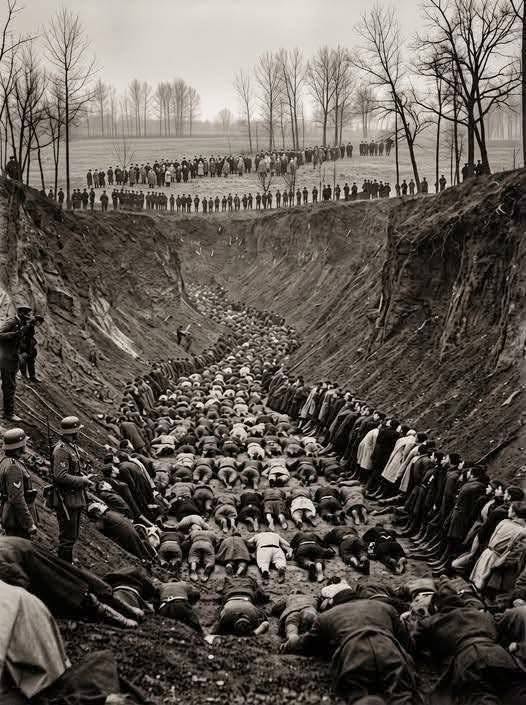
The Nazis wanted the ravine to become silent.
They wanted future investigators to find as little evidence as possible.
But they could not erase everything.
The Prisoners Who Knew Too Much
The prisoners forced to carry out the work realized that they were being used to destroy evidence of a crime that the Germans wanted to conceal.
They also knew that they had become witnesses.
As the operation neared its end in September 1943, a group of prisoners attempted to escape.
Only a small number managed to survive.
Those who escaped became important witnesses to what had happened. Their testimony helped reveal the extraordinary effort the Nazis had made to conceal the mass killings.
The Germans had tried to destroy the bodies.
They had tried to destroy the graves.
They had tried to destroy the witnesses.
But the story survived.
The Liberation of Kyiv
In November 1943, Soviet forces retook Kyiv.
The city they entered had suffered enormously during the German occupation. The scale of destruction was immense, and the full horror of what had happened at Babi Yar was gradually investigated.
The Nazis had succeeded in destroying much of the physical evidence, but they had not succeeded in destroying the memory of the victims.
Survivors spoke.
Witnesses gave testimony.
Documents were discovered.
And investigators began reconstructing what had happened at the ravine.
The number of victims from the September massacre was already recorded in German documentation, making it possible to establish an important part of the scale of the crime.
Survivors Became Witnesses
One of the most important witnesses was Dina Pronicheva, a Jewish woman who survived the September 1941 massacre.
Her testimony became one of the significant personal accounts of what happened at Babi Yar.
She had been among those taken to the ravine and managed to survive when others around her were murdered.
Her experience demonstrated the horrifying reality of the massacre from the perspective of someone who had actually been there.
Testimonies such as hers helped transform a number in a German report into something much more human: evidence of individual people who had been forced to their deaths.
Justice After the War
After the war, some of those responsible were eventually brought before courts.
The crimes committed at Babi Yar were examined during postwar investigations and trials. German police personnel involved in the massacre were prosecuted in Kyiv in 1946.
The wider Nazi killing system was also examined during the Einsatzgruppen Trial at Nuremberg.
Continue reading on the next page
