
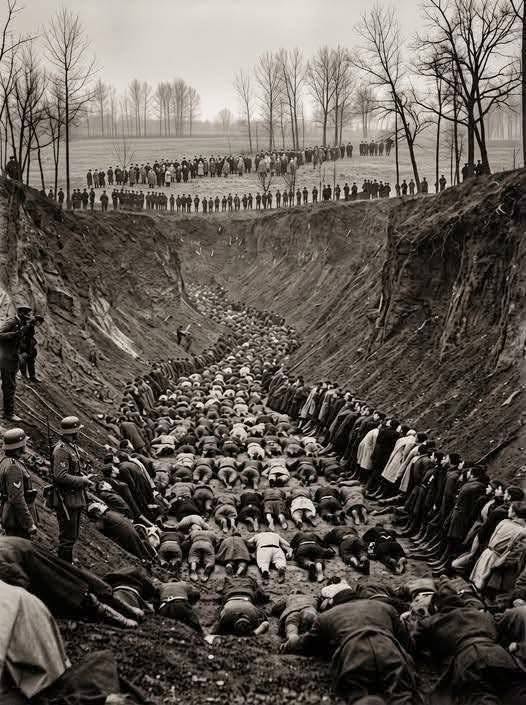
Paul Blobel, the SS officer who had commanded Sonderkommando 4a, was among those prosecuted.
He was convicted for his role in mass murder and was later executed.
The trials established an important historical fact: the mass shootings carried out in places such as Babi Yar were not random acts committed by uncontrolled soldiers.
They were part of a systematic campaign of extermination organized and implemented by Nazi Germany.
The Memory Was Complicated
Yet after the war, another struggle began—the struggle over how Babi Yar would be remembered.
During the Soviet period, the massacre was often presented primarily as the murder of Soviet civilians rather than being fully commemorated as one of the central massacres of the Holocaust.
The Jewish identity of the majority of those murdered during the September 1941 massacre was not always given the prominence it deserved in official Soviet remembrance.
This created a painful contradiction.
People knew that tens of thousands had been murdered at the ravine.
But the full story of who those victims were and why they had been targeted was not always openly discussed.
Survivors, writers, historians, and families continued to preserve the memory even when official commemoration was incomplete.
The Ravine Became a Symbol
Over time, Babi Yar came to be recognized internationally as one of the most important sites associated with the Holocaust by bullets.
Unlike the extermination camps that became symbols of industrialized killing, Babi Yar represented another aspect of the Holocaust: entire communities being marched out of their homes and murdered in mass shootings, often close to where they had lived.
The victims did not disappear anonymously into distant camps.
They were murdered near their own city.
Their families, neighbors, and communities were destroyed in a matter of days.
Behind Every Number Was a Life
The figure 33,771 can be difficult to comprehend.
It is an enormous number, but statistics can sometimes make human suffering feel distant.
Behind that number were mothers and fathers.
Children.
Grandparents.
Students.
Workers.
Neighbors.
Families.
People who had plans for the future and ordinary lives that were suddenly destroyed.
Some had believed they were following an official order that required them to move.
Some carried documents and possessions because they expected to leave their homes.
Many had no idea that they were walking toward a place of mass murder.
Continue reading on the next page
